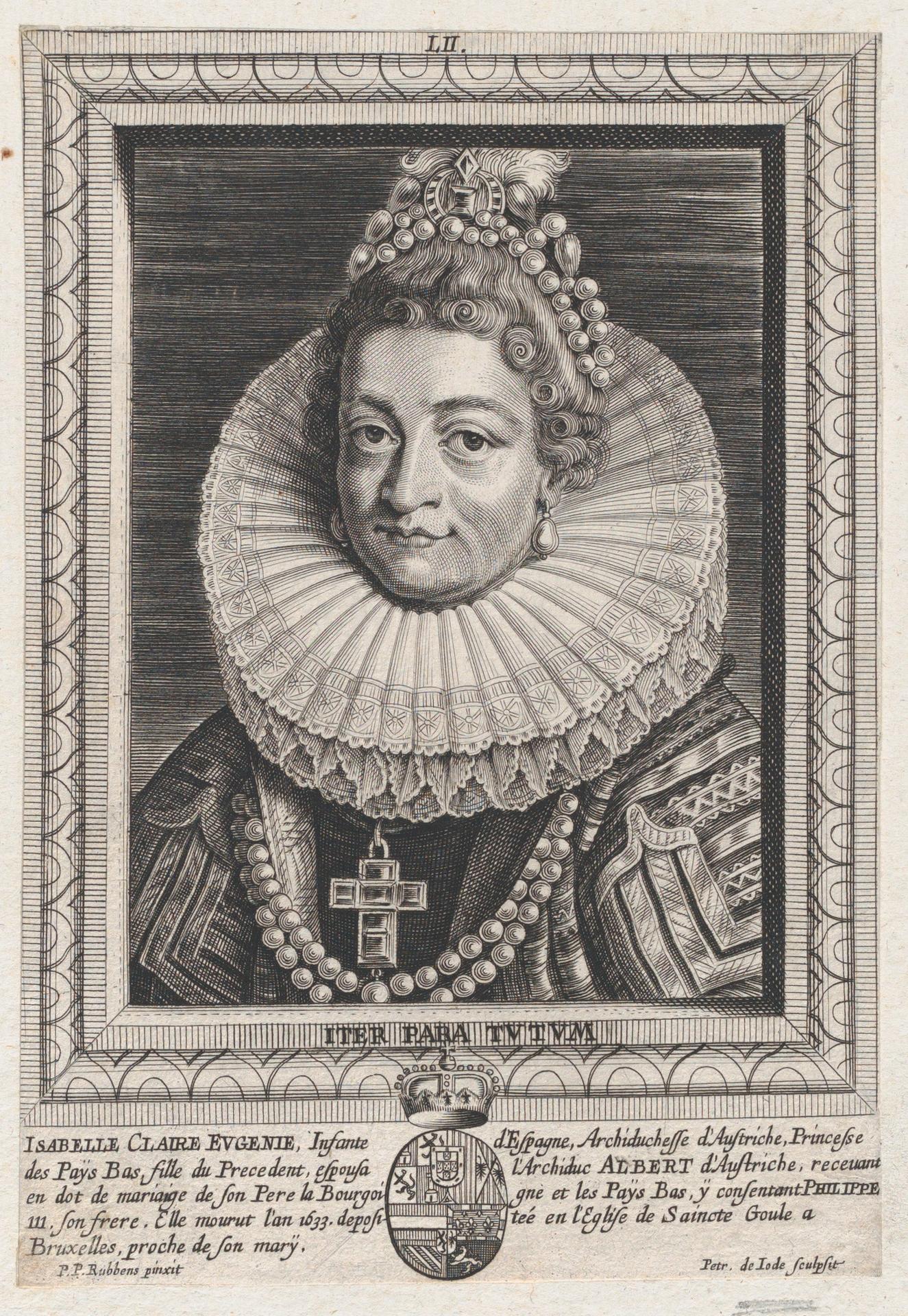
Portrait of Isabella Clara Eugenia, Infanta of Spain
Original title: Portrait of Isabella Clara Eugenia, Infanta of Spain
kurzbeschreibung
Pieter de Jode II produced this portrait of the Spanish Infanta Isabella Clara Eugenia around 1650 as an engraving. The regent appears in a ceremonial dress with rich ornament and a cross pendant, standing out against a dark, undifferentiated background.
Description
As a bust-length portrait, the Infanta fills the picture surface in a nearly mirror-symmetrical arrangement; her face lies at the center. She wears a precious gown with embroidery and pearls, along with a ruffled crown and a bow with a cross pendant. The dark, plain background makes the figure stand out clearly. The lines are precise and rich in detail, as is characteristic of 17th-century printmaking. At the bottom are a text field and a coat of arms.
Context
Isabella Clara Eugenia (1566–1633) was Infanta of Spain and governor of the Spanish Netherlands. This print was made around 1650, about twenty years after her death, and belongs to a series of prints that disseminated portraits of princes. Pieter de Jode II, a Flemish engraver, worked in Antwerp and Paris. Such portraits served representation and the spread of the sitter's image.
Impact
The symmetrical arrangement and the dark ground give the image a calm and dignified effect. The many embellishments of the gown and the clear linework lend the portrait a solemn, representative aura. The monochrome execution directs the gaze entirely to the person and her insignia.
Technique
This print is an etching, an intaglio process in which the drawing is incised into a metal plate etched with acid. The lines are delicate and regular, suggesting careful work by the engraver. The paper is trimmed, and the dimensions are 17.1 × 11.7 cm.
AI-generated description text
Source: Metropolitan Museum of Art · Public Domain (CC0 1.0)