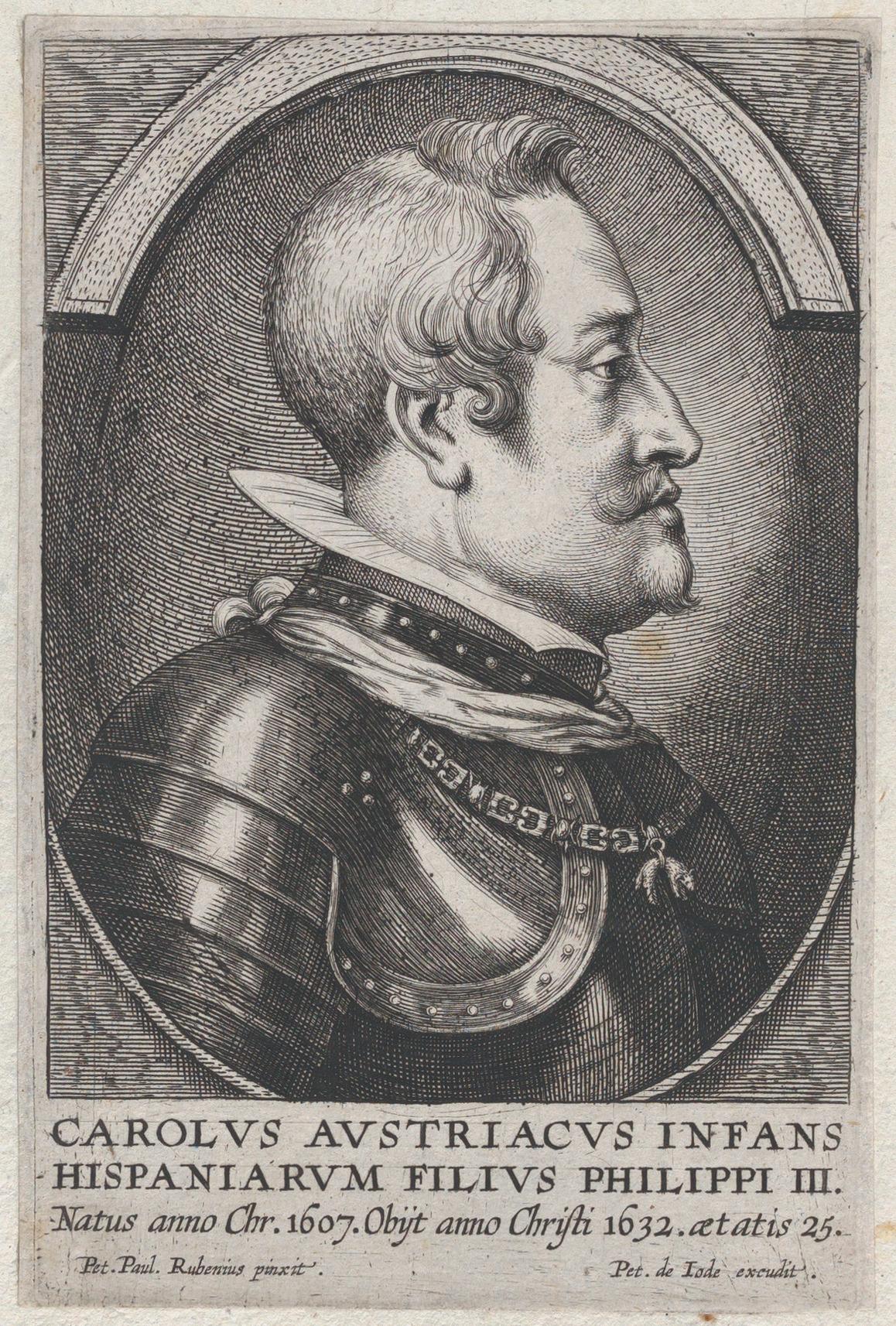
Portrait of Charles of Austria, Infante of Spain, in profile to the right
Original title: Portrait of Charles of Austria, Infante of Spain, in profile to the right
kurzbeschreibung
Around 1650, Pieter de Jode II engraved a portrait of Infante Charles of Austria, a son of Philip III of Spain, shown in profile facing right. The prince wears plate armor with metal buckles, his hair short and wavy, and a sash around his neck. The trimmed sheet measures 14.1 × 9.3 cm.
Description
Your eye is first drawn to the severe right-facing profile, which emerges from a dark ground. The infante's armor is elaborately engraved, with plates and buckles clearly defined. Short, wavy hair and the sash at his neck are rendered with great precision. A semicircular border encloses the portrait, and below it Latin inscriptions give the dates 1607–1632 and state that the sitter was 25 years old. The text names Pet. Paul. Rubens as the painter of the model and Pet. de Iode as the engraver.
Context
Infante Charles of Austria, born in 1607, was a son of Philip III of Spain and died in 1632 at the age of 25. The engraving is based on a painting by Peter Paul Rubens made around 1628. Pieter de Jode II produced the copperplate around 1650, roughly twenty years after the prince's death; it was likely intended as a posthumous portrait for a genealogical or court publication.
Impact
The strict side view and the meticulously worked armor give the portrait a dignified distance. Clear lines guide the eye steadily across the forms, creating a precise, almost medal-like effect. In this way the young infante's claim to authority is emphasized without the image needing to be loud.
Technique
For this engraving, lines were cut into a copperplate and then printed on paper. Fine hatching shapes the facial features and armor, while the inscriptions are in typical engraved lettering. The sheet has been trimmed, so the original margin and any possible losses are no longer visible.
AI-generated description text
Source: Metropolitan Museum of Art · Public Domain (CC0 1.0)