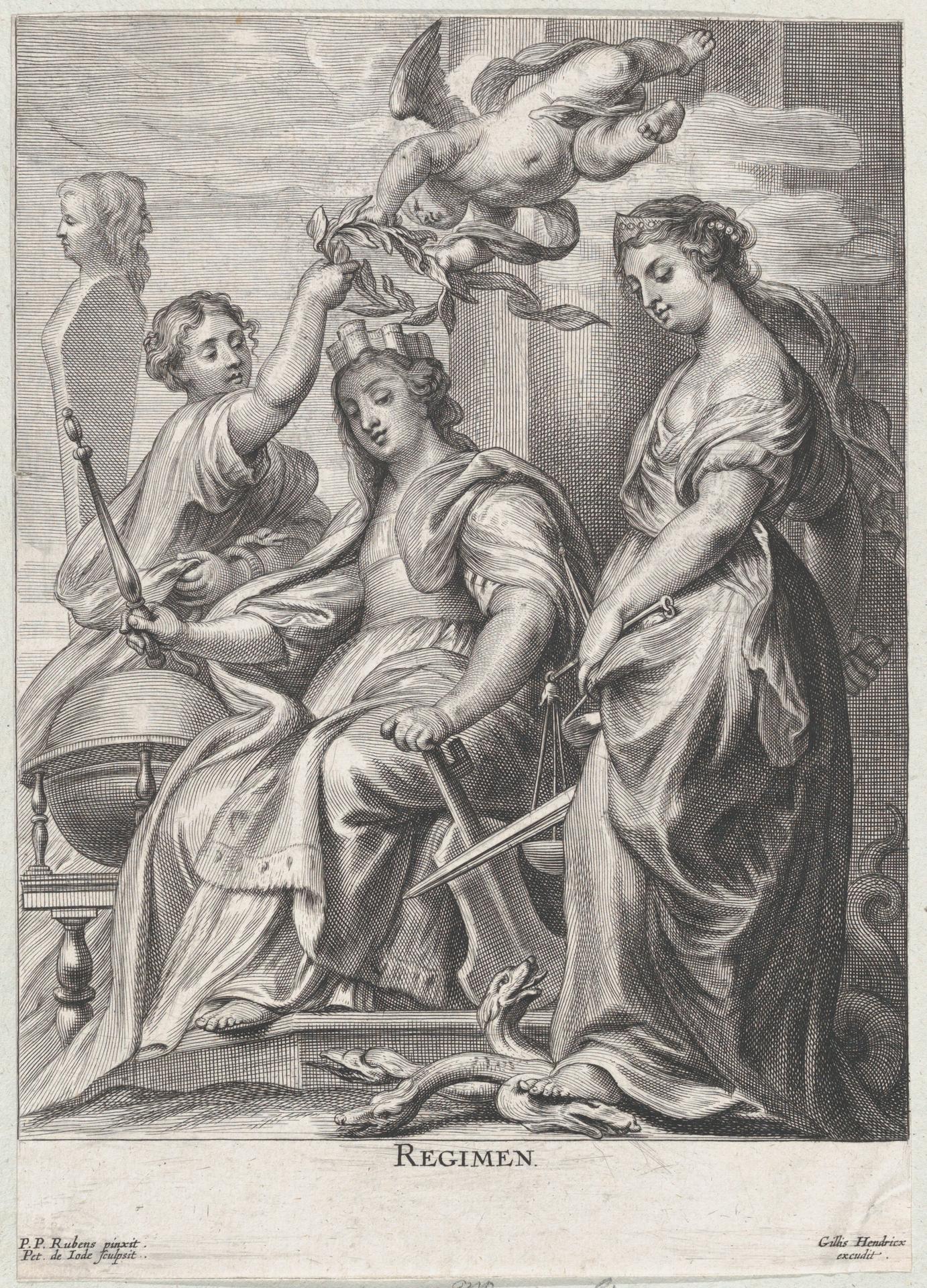
Allegory of Good Government, seated at center and being crowned by a putto and a woman at left, Justice standing atop a hydra at right
Original title: Allegory of Good Government, seated at center and being crowned by a putto and a woman at left, Justice standing atop a hydra at right
kurzbeschreibung
Between 1640 and 1674 Pieter de Jode II produced the engraving Allegory of Good Government. A throned female figure personifies good rule; a putto and a woman with scales crown her. On the right, Justice stands on a hydra, the symbol of vice.
Description
A woman with a small crown and sword sits at the center of the image. Above her hovers a putto holding a crown ready. To her left stands a woman with scales, to her right another figure, also with scales; behind them appears a person with a shield. In the lower right crouches a dragon, and along the bottom edge one reads the word REGIMEN.
Context
Pieter de Jode II, a Flemish Baroque engraver, worked in Antwerp and later in England. In his time, printed sheets often served political iconography, making virtues such as justice and good governance visible. This work belongs to a series of allegories that were widespread in the seventeenth-century Netherlands.
Impact
The symmetrical arrangement of the figures and the central placement of the government allegory give the image a balanced, dignified bearing. Clear lines and a calm layout create a solemn, moralizing mood that prompts the viewer to reflect on good governance.
Technique
In this engraving, the motif is incised into a copper plate. Fine lines and hatching model plastic shadows and bring out the figures in rich detail. The impression was taken on paper; the trimmed sheet measures 26.2 × 18.7 cm.
AI-generated description text
Source: Metropolitan Museum of Art · Public Domain (CC0 1.0)