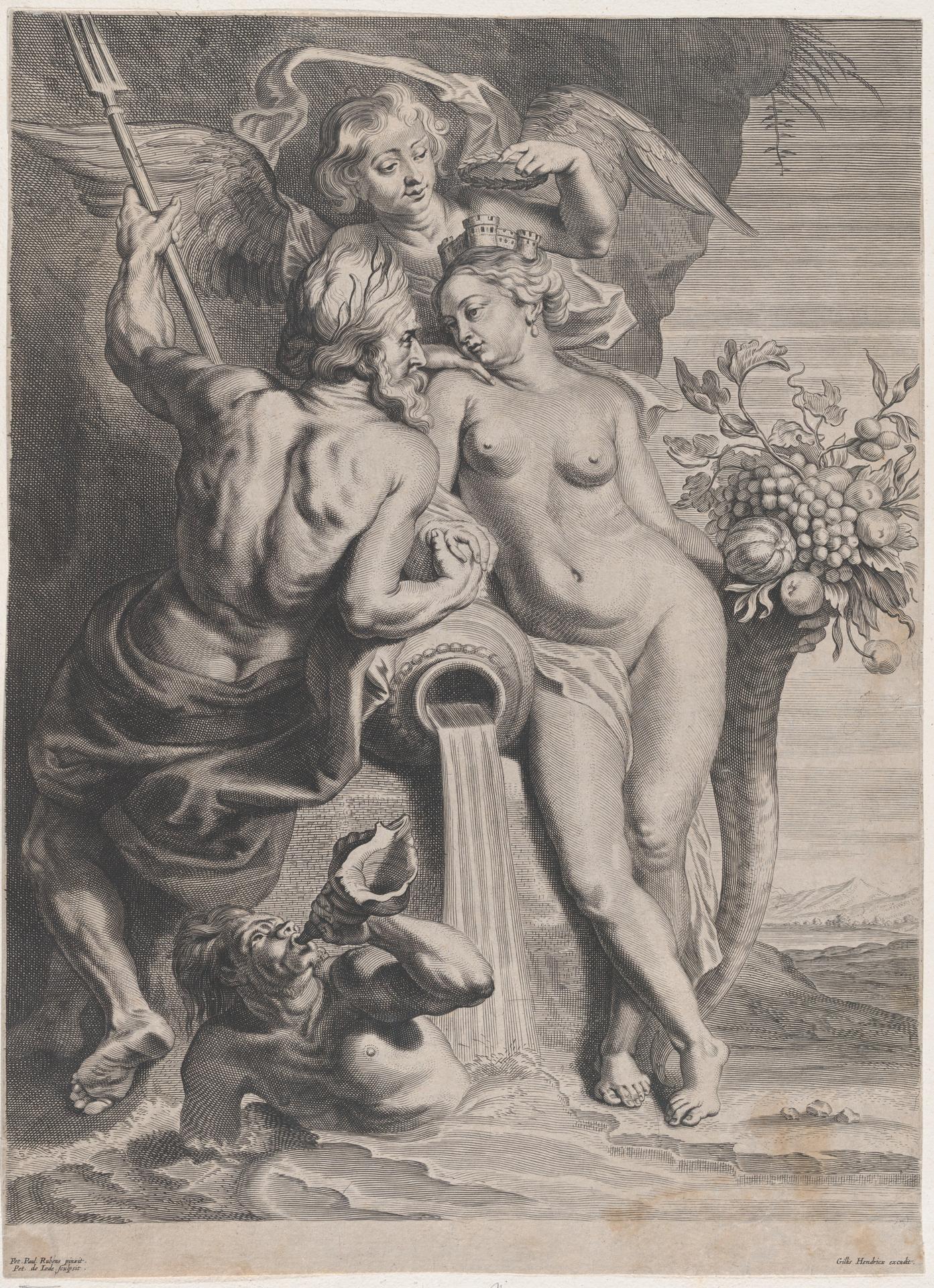
Neptune and Cybele
Original title: Neptune and Cybele
kurzbeschreibung
Between 1640 and 1674, Pieter de Jode II produced the engraving Neptun und Cybele, which brings together the sea god Neptune and the goddess Cybele in a mythological scene. The print is the second state of two and measures 43.3 × 31.6 cm.
Description
Neptune, muscular and wearing a sash, holds a trident and stands in the foreground. Cybele is enthroned on a water-washed pedestal, wears a crown, and is flanked by a sheaf of fruit. At her feet a man kneels, and Neptune splashes him with water. A winged angel touches Cybele with an object. The classical style of the print is enlivened by carefully graded areas of light and shadow.
Context
The Fleming Pieter de Jode II worked as a Baroque engraver in Antwerp and later in Amsterdam. His activity fell in the mid-17th century, when printed mythological scenes were in strong demand. The engraving was likely made as a reproduction after a painting or drawing and probably belonged to a series of mythological depictions. The patron and exact purpose are not recorded.
Impact
The detailed execution and clear layout effectively bring the figures into the light. Contrasts of light and dark create spatial depth and emphasize the bodies' physical presence. The result is a lofty, classical atmosphere characteristic of mythological images from that era.
Technique
For printing, the motif was engraved into a copper plate and then pulled onto paper. The lines appear fine and precise, which speaks to the engraver's high level of craftsmanship. In the second state, the plate was reworked after the first impression to sharpen or alter details.
AI-generated description text
Source: Metropolitan Museum of Art · Public Domain (CC0 1.0)