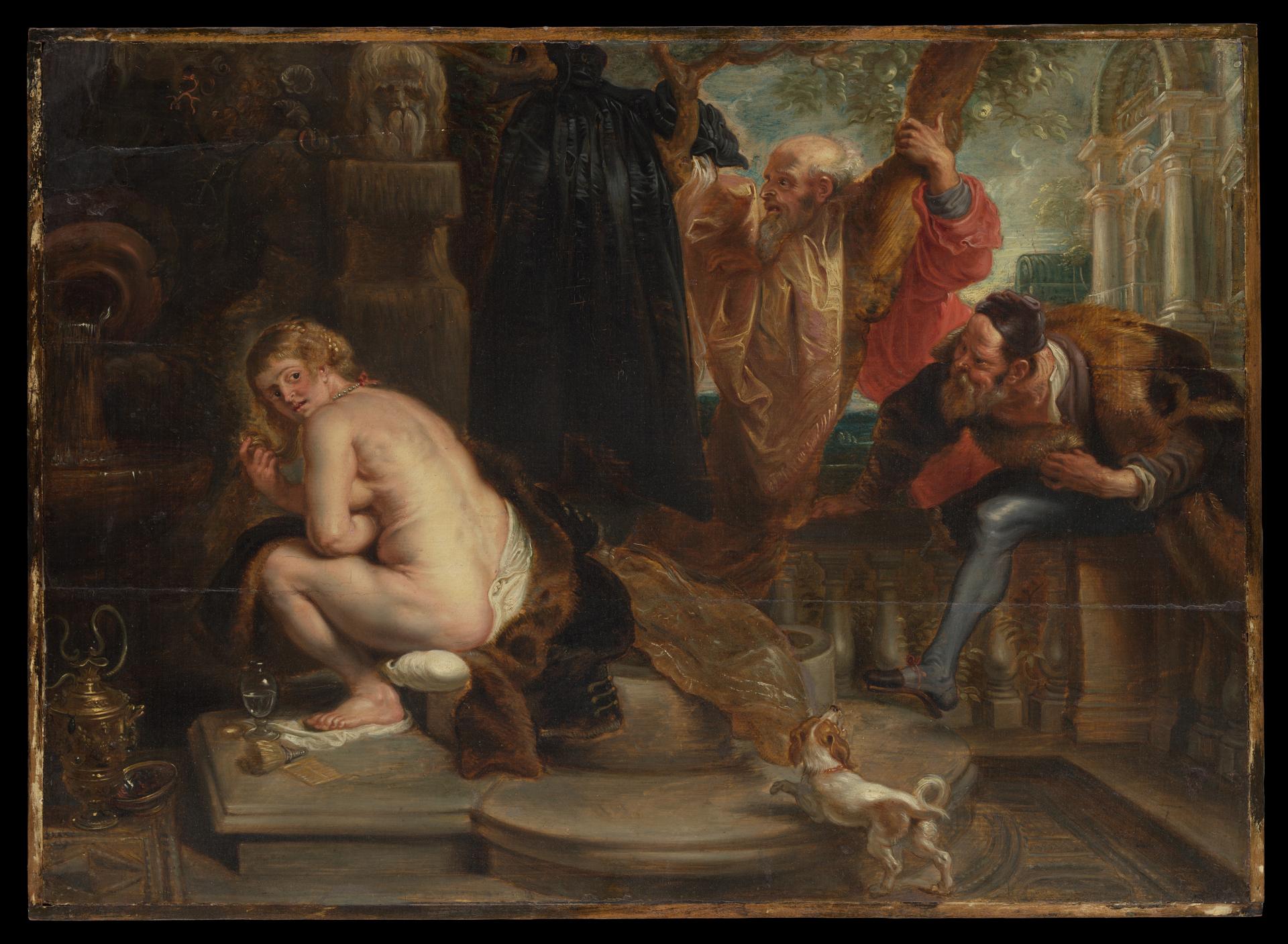
Susanna and the Elders
Original title: Susanna and the Elders
kurzbeschreibung
Peter Paul Rubens's painting Susanna and the Elders presents the biblical encounter in which the chaste Susanna is accosted by two elderly men. Undated and executed in oil on wood, it places the young woman at the front while the elders appear behind her.
Description
Susanna sits in the foreground on a pedestal, a white cloth wrapped around her hips; her posture is shy and withdrawn. A dog beside her looks up at her in agitation. Three older men stand in the background, gazing in different directions: one in a long black cloak with a staff, another in a brown robe, the third in red. The setting is an interior with columns and a window that opens onto a landscape. Muted tones and soft light create a tense, dramatic mood.
Context
Rubens painted the picture during the Baroque, an era known for dramatic scenes and vivid storytelling. The story of Susanna and the elders was a popular subject in the seventeenth century, one that dealt with virtue and moral steadfastness. As a leading master of the Flemish Baroque, Rubens knew how to capture moments of emotion and narrative.
Impact
The muted colors and soft light produce an atmosphere at once tense and intimate. Susanna's reserved pose stands in contrast to the presence of the older men, making the moral threat visible. The arrangement draws the eye to the main figure and heightens the emotional impact of the moment.
Technique
Rubens worked in oil on wood, a technique common in the Baroque that allows fine detail and rich gradations of color. His handling shows careful layering of paint to achieve soft transitions and dramatic lighting. Wood as a support was customary at the time for small-format paintings.
AI-generated description text
Source: Metropolitan Museum of Art · Public Domain (CC0 1.0)