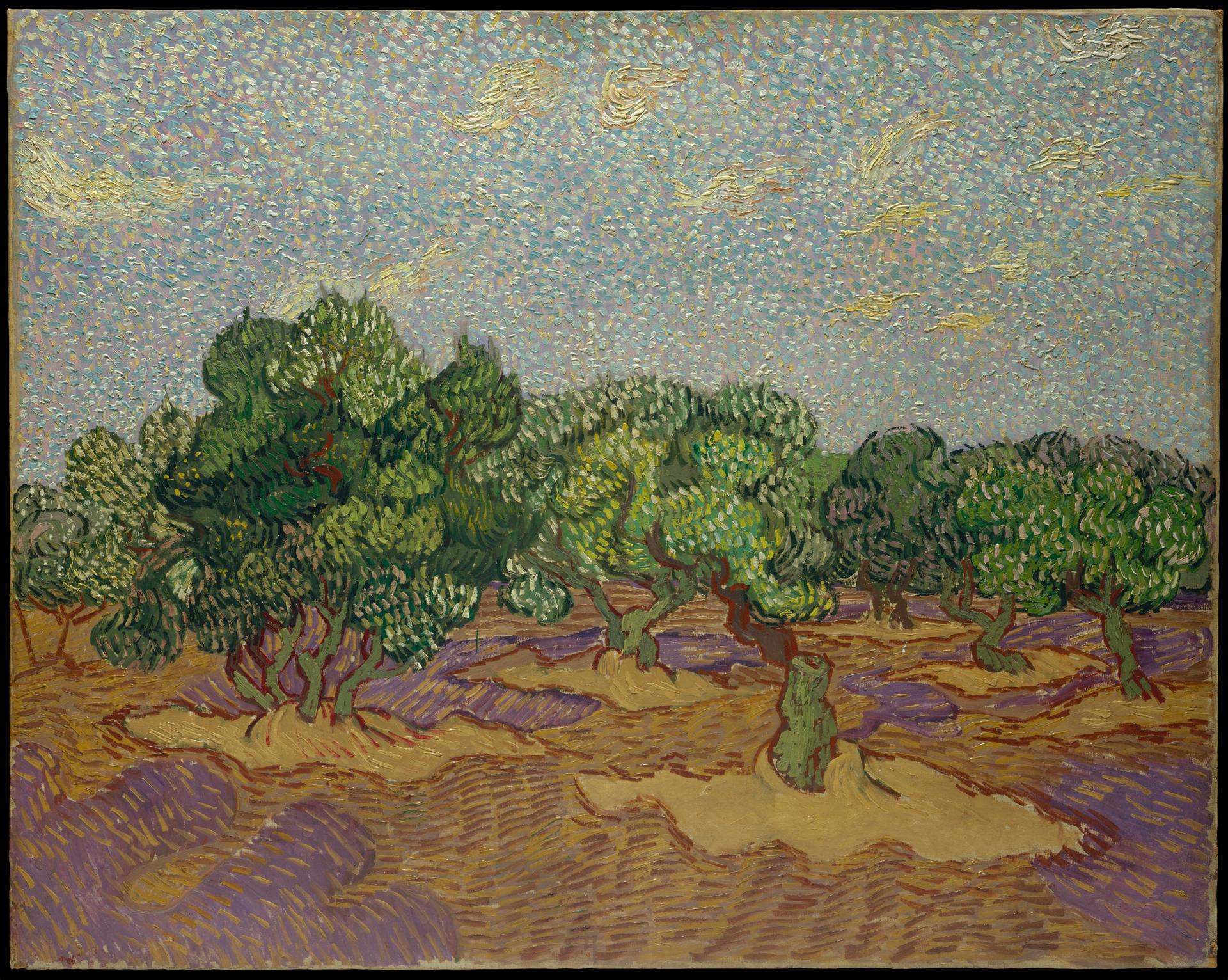
Olive Trees
Original title: Olive Trees
kurzbeschreibung
Olive Trees, painted in 1889 by Vincent van Gogh in oil on canvas, belongs to a group of works made during his stay in Provence, where he returned to the same landscape motif again and again.
Description
Several olive trees crowd into the picture, their dense green leaves varying greatly in size and outline. The ground beneath glows in warm earth tones, crossed by visible streaks that hint at the texture of the soil. Behind the front trees, more trees stagger into depth and open the view onto a broad landscape. Thin white clouds drift across the sky in shifting shapes. Green dominates the foliage, earth tones the ground, blue the upper area.
Context
In 1889, during his time at the Saint-Paul-de-Mausole asylum near Saint-Rémy-de-Provence, van Gogh took up the olive trees of the surroundings repeatedly. They were among the motifs that occupied him most intensely during this phase. In a period of high productivity, he explored the southern French landscape and translated it into numerous paintings.
Impact
Strong colors and a restless brushstroke give the view something immediate, almost pulsating. Calm and movement balance each other in the picture's structure, producing a gathering, meditative mood.
Technique
Oil paint on canvas, applied thickly. The areas of color are built from small, irregular dots and flecks — a method reminiscent of pointillism, though van Gogh handles it more freely and expressively here.
AI-generated description text
Source: Metropolitan Museum of Art · Public Domain (CC0 1.0)