Reproductive Print of the Miracles of St. Francis Xavier Altarpiece
Original title: Reproductive Print of the Miracles of St. Francis Xavier Altarpiece
kurzbeschreibung
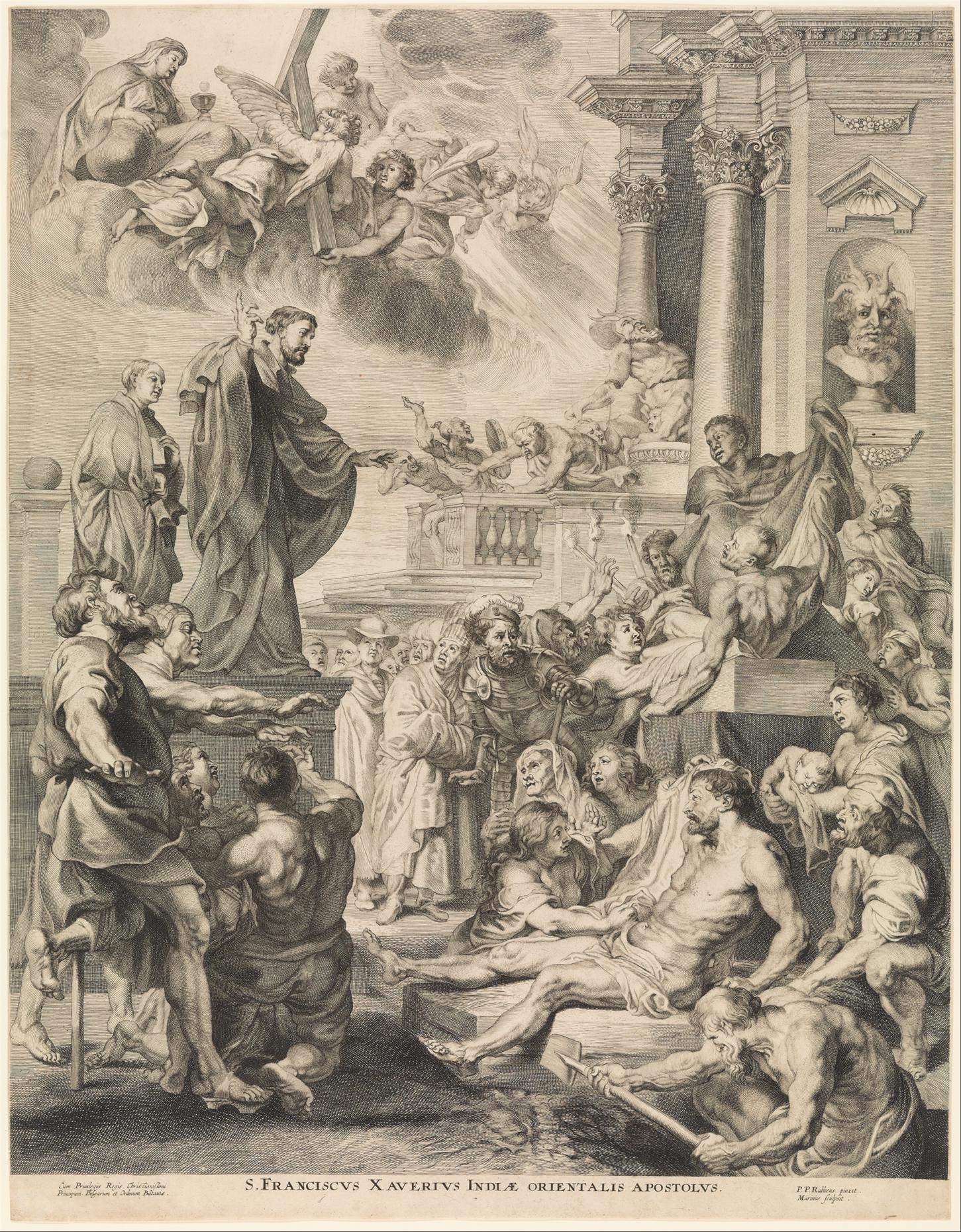
Between 1615 and 1639, Ignatius Cornelis Marinus produced an engraving that reproduces an altarpiece dedicated to the miracles of Saint Francis Xavier. The original painting focused on those miracles. This upright print measures 57.2 x 44.6 cm and presents the saint preaching within a rich scene populated by angels.
Description
Saint Francis Xavier occupies the central position, dressed in a long-sleeved robe, one hand raised in a gesture. Crowds press around him: some figures recline on the ground, others look up at him, and still others appear to float in the air. Columns and a relief with a head can be made out in the distance. The postures and expressions of the figures vary widely, heightening the dramatic impression. Executed in a single color, the image features precise, sharp lines in the Baroque style, which emphasizes movement and expression.
Context
Francis Xavier (1506–1552) belonged to the Jesuit order and worked as a missionary, mainly in Asia, where numerous miracles were attributed to him. The altarpiece reproduced here was likely created around the time of his canonization in 1622, which fostered his veneration. The Dutchman Ignatius Cornelis Marinus made this reproduction in the early 17th century, a period when graphic copies of altarpieces were widespread for spreading religious themes. The engraving probably served devotion and helped promote the saint's cult in Europe.
Impact
The detailed arrangement and animated figures create a strong religious drama. Clear lines and the accurate rendering of the scenes produce a solemn, almost theatrical mood that draws the viewer into the narrative of the miracles. The monochrome approach brings the narrative details and the expressive gestures of the figures to the fore.
Technique
This sheet is a copper engraving. Lines are incised into a copper plate with a burin and then printed onto paper. This allows for fine, exact lines and a high level of detail, which suits the reproduction of complex figure scenes. The plate is inked with printing black and pulled on paper, resulting in the monochrome appearance.
AI-generated description text
Source: Metropolitan Museum of Art · Public Domain (CC0 1.0)