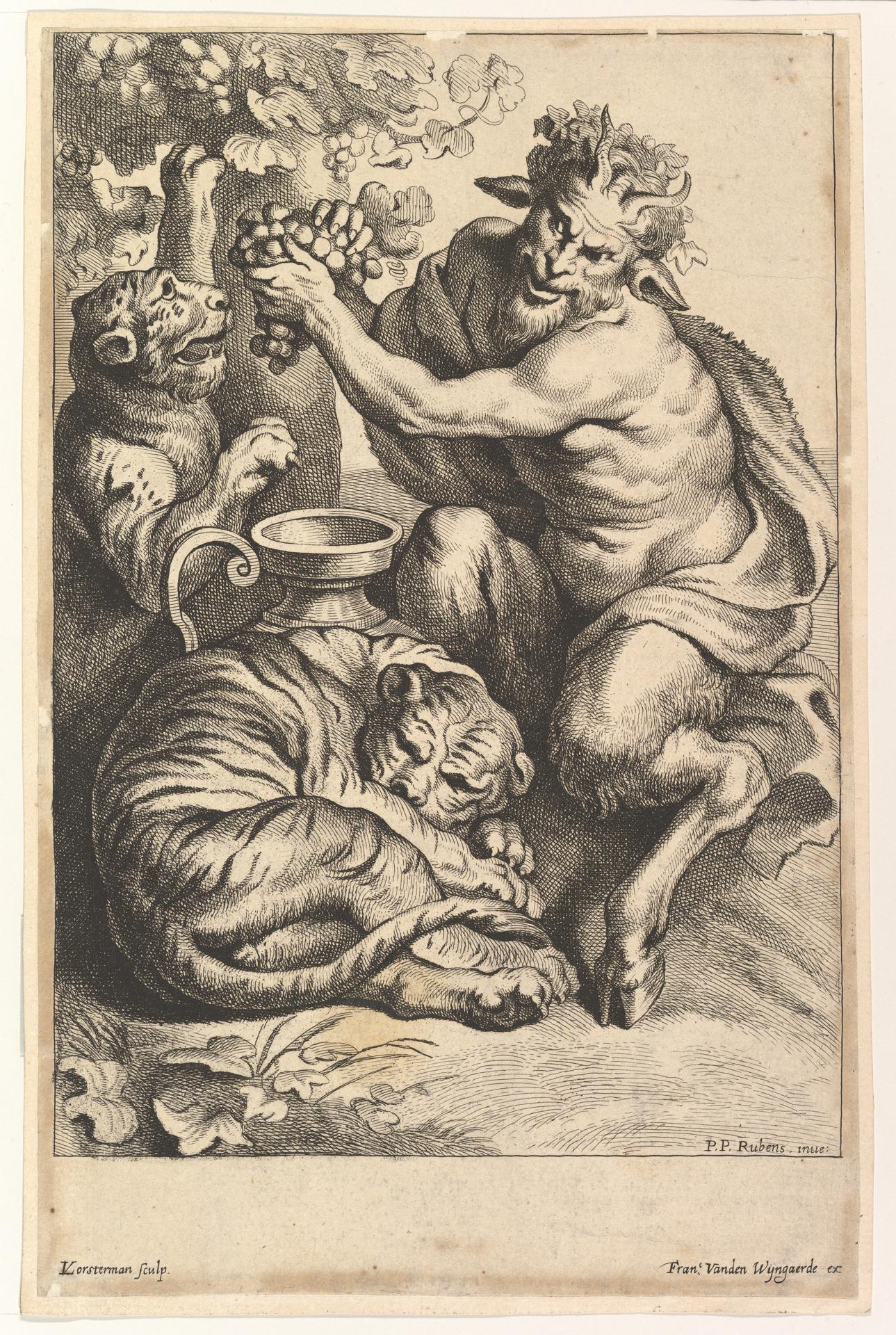
Satyr with Grapes and Two Tigers
Original title: Satyr with Grapes and Two Tigers
kurzbeschreibung
Lucas Vorsterman II made this etching of a satyr holding grapes, flanked by two tigers — one asleep, one awake. The print dates from between 1614 and 1679 and is the second of two states. The mythological subject is handled with movement and rendered in black and white.
Description
A strong satyr with a leaf wreath grips a bunch of grapes. Beside him a sleeping tiger rests, while a second tiger looks up at him alertly. Vines suggest the setting. The arrangement is lively and puts the figures at the center. Close hatching and lines define the monochrome image. At lower right appears the inscription: P.P. Rubens, Vorsterman sulp. and Fran. Vanden Wyngaerde ec.
Context
Lucas Vorsterman II, a seventeenth-century Flemish engraver, often worked from designs by Peter Paul Rubens. This etching was likely produced in Antwerp, then a hub of printmaking. A satyr as a companion of the wine god Dionysus was a popular Baroque motif, linking nature, sensuality, and myth. The mention of Rubens in the inscription points to the close collaboration between him and the engravers in his workshop.
Impact
Precise lines and animated figures give the sheet strong sculptural presence despite its monochrome technique. The pairing of the muscular satyr with the exotic tigers creates tension and holds the eye. Subtle shading adds atmospheric depth, characteristic of printmaking in Rubens's circle.
Technique
This work is an etching, an intaglio process in which the drawing is scratched into a wax layer on a metal plate and then bitten with acid. Two states exist, meaning the plate was reworked after the first printing, probably to sharpen details. Printing in black ink on paper yields the monochrome effect, with lines and hatching modeling light and shadow.
AI-generated description text
Source: Metropolitan Museum of Art · Public Domain (CC0 1.0)