Palazzi di Genova
Original title: Palazzi di Genova
kurzbeschreibung
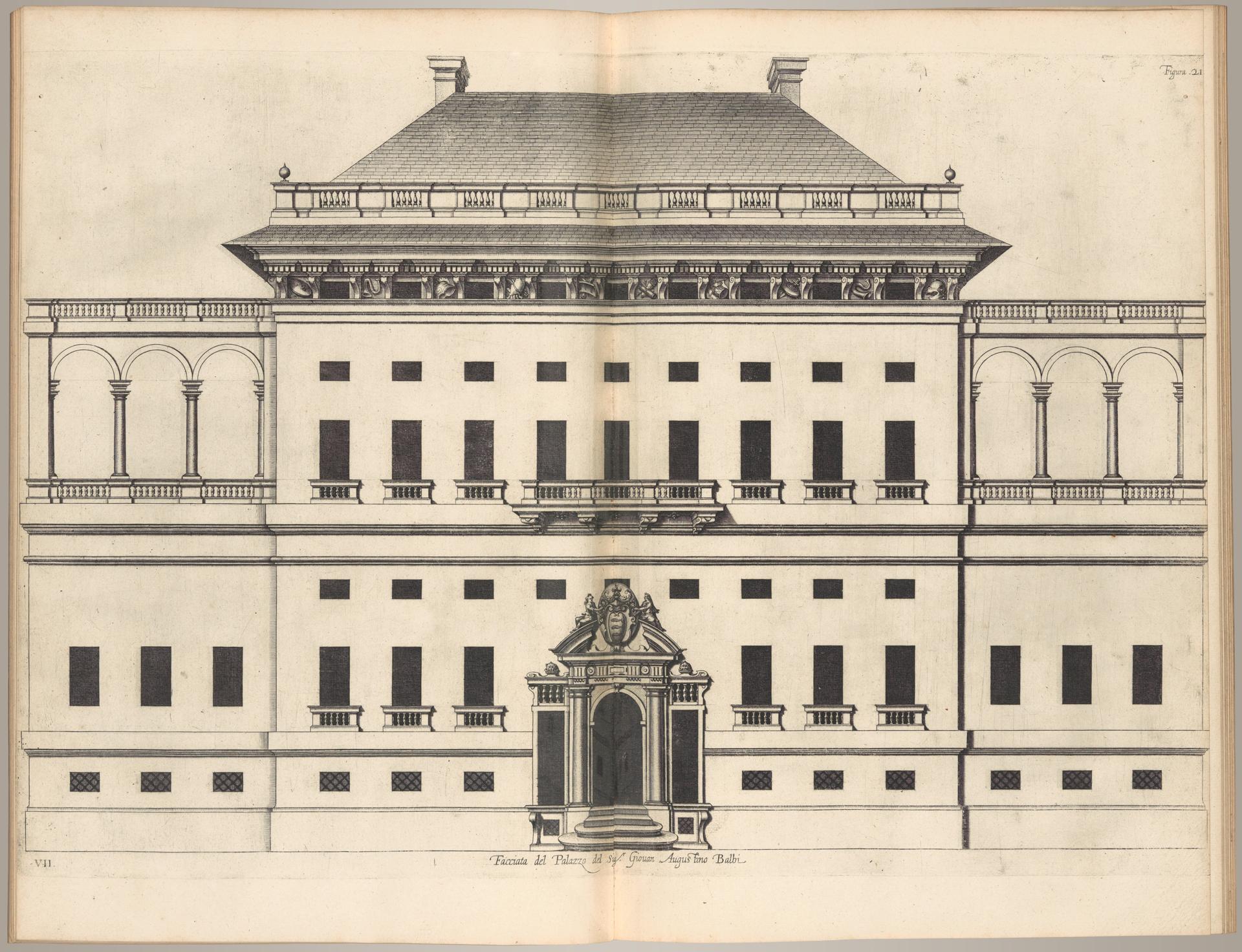
Peter Paul Rubens published the 'Palazzi di Genova' in 1622, a collection of printed text and etched plates. One of these plates shows the facade of a Genoese city palace as an exact architectural record. The sheet belongs to a series that grew out of Rubens' years in Italy.
Description
A semicircular portico with a coat of arms spans the central door, and above it a balustraded balcony framed by columns opens up. The facade rises through several storeys, their window bays evenly spaced; continuous columns articulate the wall across the floors. On the flat roof stands a row of chimneys. Everything is drawn in black and white, with cleanly controlled lines and no colour at all.
Context
Between 1600 and 1608 Rubens stayed in Italy and absorbed the architecture of Genoa. For the 'Palazzi di Genova', published in Antwerp in 1622, he drew on his own sketches and measured surveys. Architects and art lovers used the book as a reference work; it bears witness to the period's interest in the architecture of the Italian Renaissance.
Impact
The symmetrical arrangement creates a calm, orderly impression and brings out the grandeur of the building. The even linework feels objective and documentary; the eye is directed to the individual architectural parts.
Technique
Printed text and etched plates come together here, as was customary for 17th-century architectural publications. Etching allows thin, uniform lines that are suited to the precise reproduction of building details.
AI-generated description text
Source: Metropolitan Museum of Art · Public Domain (CC0 1.0)