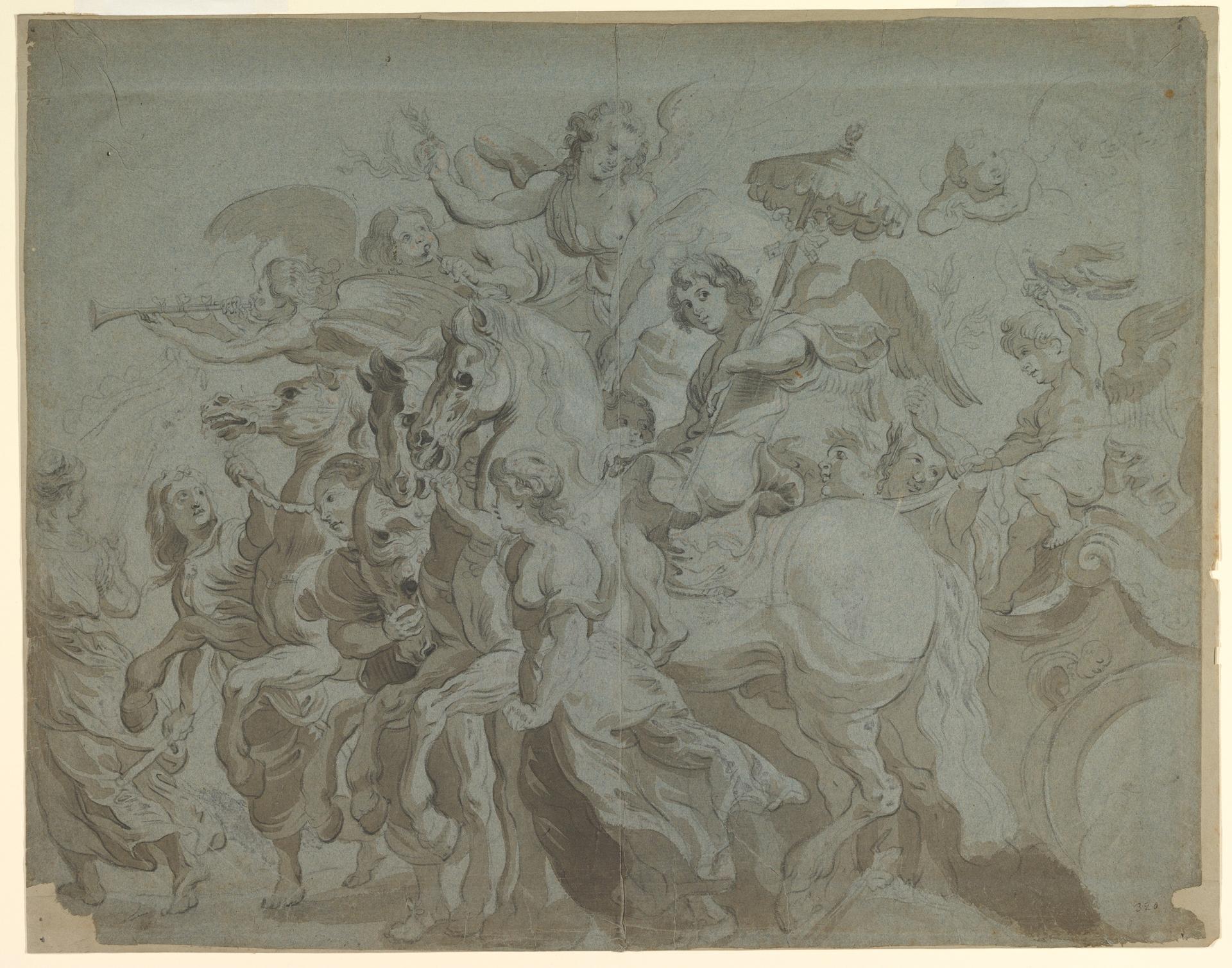
Triumph of the Eucharist
Original title: Triumph of the Eucharist
kurzbeschreibung
Where related allegories of the Eucharist often crowd the triumph into dense, overloaded scenes, this anonymous Flemish sheet from the mid-seventeenth century opts instead for a clear processional structure. Drawn on blue paper in black and brown, it places a mounted figure in a pose of victory at its heart, surrounded by music-making angels.
Description
A rider in triumphant posture dominates the middle of the sheet, while angels in shifting poses cluster around him, blowing flutes and trumpets. Faint further figures suggest themselves further back and extend the train. Grey tones prevail, threaded with brown and white accents, and the blue paper lends the ground a faint shimmer. Flowing drapery lines and the restlessness of the figures give the arrangement movement and tension.
Context
Made in seventeenth-century Flanders, a region with a pronounced artistic tradition, the work belongs to the orbit of the Catholic Counter-Reformation, which attached particular importance to the Eucharist. Its reading as a triumphal procession reflects that stance. Anonymous artists of the period frequently produced religious allegories for churches or private devotional rooms.
Impact
The animated structure and the solemn angels call up a triumphant, grave mood. Because drawing and washed painting interlock, a lively, almost theatrical presence emerges that draws the viewer into the event.
Technique
Black chalk served for the drawing, brown ink for the wash, and white gouache for the highlights. Blue paper as a support deepens the colour effect and brings the light passages forward.
AI-generated description text
Source: Metropolitan Museum of Art · Public Domain (CC0 1.0)