Atalanta and Meleager (1618–84)
Original title: Atalanta and Meleager
kurzbeschreibung
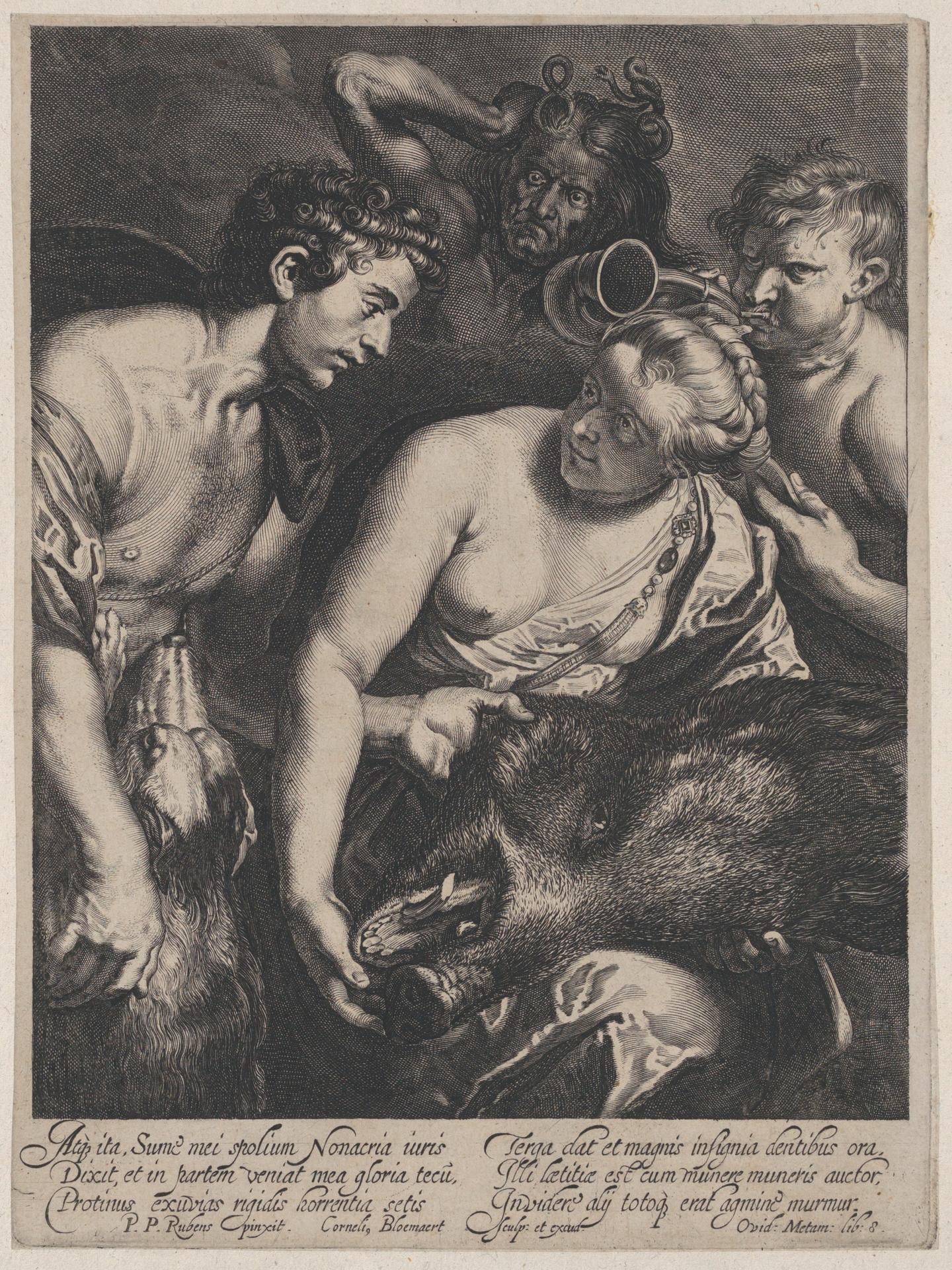
Cornelis Bloemaert produced the engraving Atalanta and Meleager between 1618 and 1684. This second state of two captures the two mythological figures in a close encounter, measuring 22.8 × 17.1 cm. Atalanta and Meleager appear in classicizing dress, accompanied by other figures and set against a dark, textured landscape.
Description
Atalanta, recognizable by her long braided hair and flowing garment, holds a flower. Opposite her stands Meleager, with short curly hair, also barefoot and draped in cloth. Their eyes meet. Behind them, a figure with horns and a horn on his head hints at a mythological connection. Two more figures are only partially visible, one of them carrying a horn. The dark, textured backdrop makes the figures stand out; shading is built from fine lines and strokes. Latin inscriptions along the bottom edge explain the scene's context.
Context
Cornelis Bloemaert was a seventeenth-century Dutch engraver known for his detailed reproductions after paintings. This print likely belonged to a series of mythological subjects popular in the Baroque era. The theme of Atalanta and Meleager refers to the Greek legend of the Calydonian boar hunt: Atalanta wounds the boar, and Meleager kills it. The Latin inscriptions at the bottom point to a literary source, probably Ovid's Metamorphoses, often used as a model for Baroque art.
Impact
The exchanged glances of the main figures create an intimate yet dynamic tension that draws the viewer into the mythical narrative. The dark, textured setting contrasts with the bright figures, giving the scene a dramatic, almost theatrical effect. The precise execution and clear arrangement of the figures make this print a telling example of Baroque printmaking.
Technique
For this engraving, lines were incised into a copper plate and then printed. Varying densities and directions of strokes produce subtle gradations of light and dark. The second state of the print suggests revisions from the first, typical of seventeenth-century printmaking.
AI-generated description text
Source: Metropolitan Museum of Art · Public Domain (CC0 1.0)