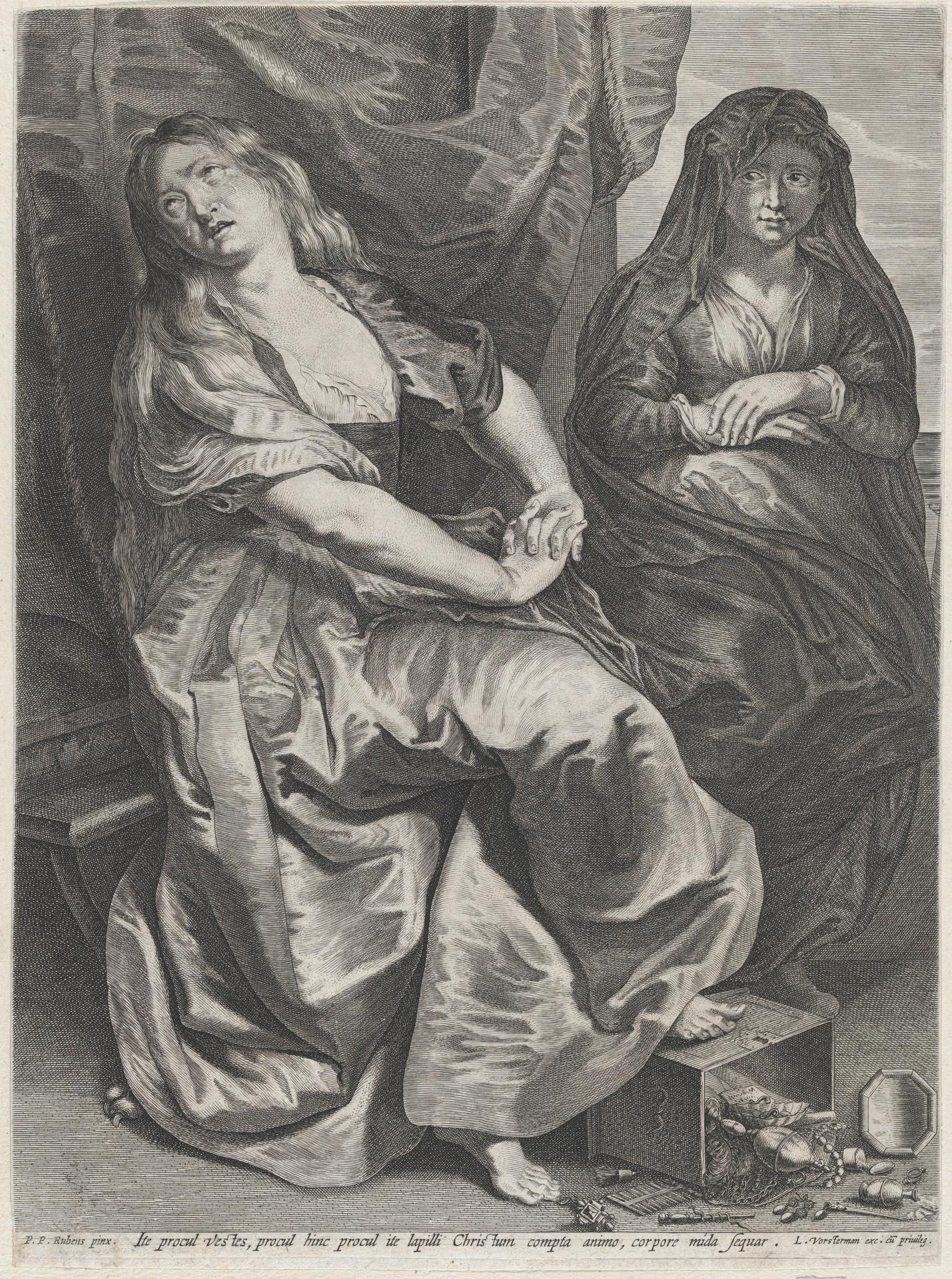
St. Mary Magdalen Trampling Her Valuables (1622–23, Met-Objekt 1084)
Original title: St. Mary Magdalen Trampling Her Valuables
kurzbeschreibung
Lucas Vorsterman I produced this engraving in 1622–23 as a reproduction after a painting by Peter Paul Rubens. It depicts Saint Mary Magdalene seated in an armchair with her jewellery and other worldly possessions lying at her feet. The print measures 30 × 22.3 cm and is the first of three states (Hollstein).
Description
Two women dominate the image, arranged symmetrically. Mary Magdalene sits enthroned in an armchair, arms crossed over her chest, her long hair flowing over her shoulder. Opposite her sits a second woman, hands in her lap. Both wear voluminous garments whose folds are worked out with fine lines. At the feet of the seated woman lie a small box, trinkets and other personal items. Suggested curtains and a wall close off the back; the light appears subdued and highlights the surfaces.
Context
This print comes from the workshop of Peter Paul Rubens, who in the 1620s commissioned numerous reproductive engravings after his paintings. Lucas Vorsterman I was one of the leading engravers of his time and worked closely with Rubens. The figure of the penitent Magdalene spurning worldly wealth was a common motif of the Counter-Reformation and spread widely across Europe through printed reproductions.
Impact
The engraving thrives on detailed, fluid linework that effectively translates the baroque drama of the figures and fabrics. The restriction to black and white brings the pictorial structure and lighting to the fore and creates a calm, contemplative mood.
Technique
As an engraving, this print belongs to the intaglio processes: the lines are cut into a metal plate and then transferred to paper with printing ink. Vorsterman used fine cross-hatching to model shadows and garment folds—a hallmark of baroque reproductive printmaking.
AI-generated description text
Source: Metropolitan Museum of Art · Public Domain (CC0 1.0)