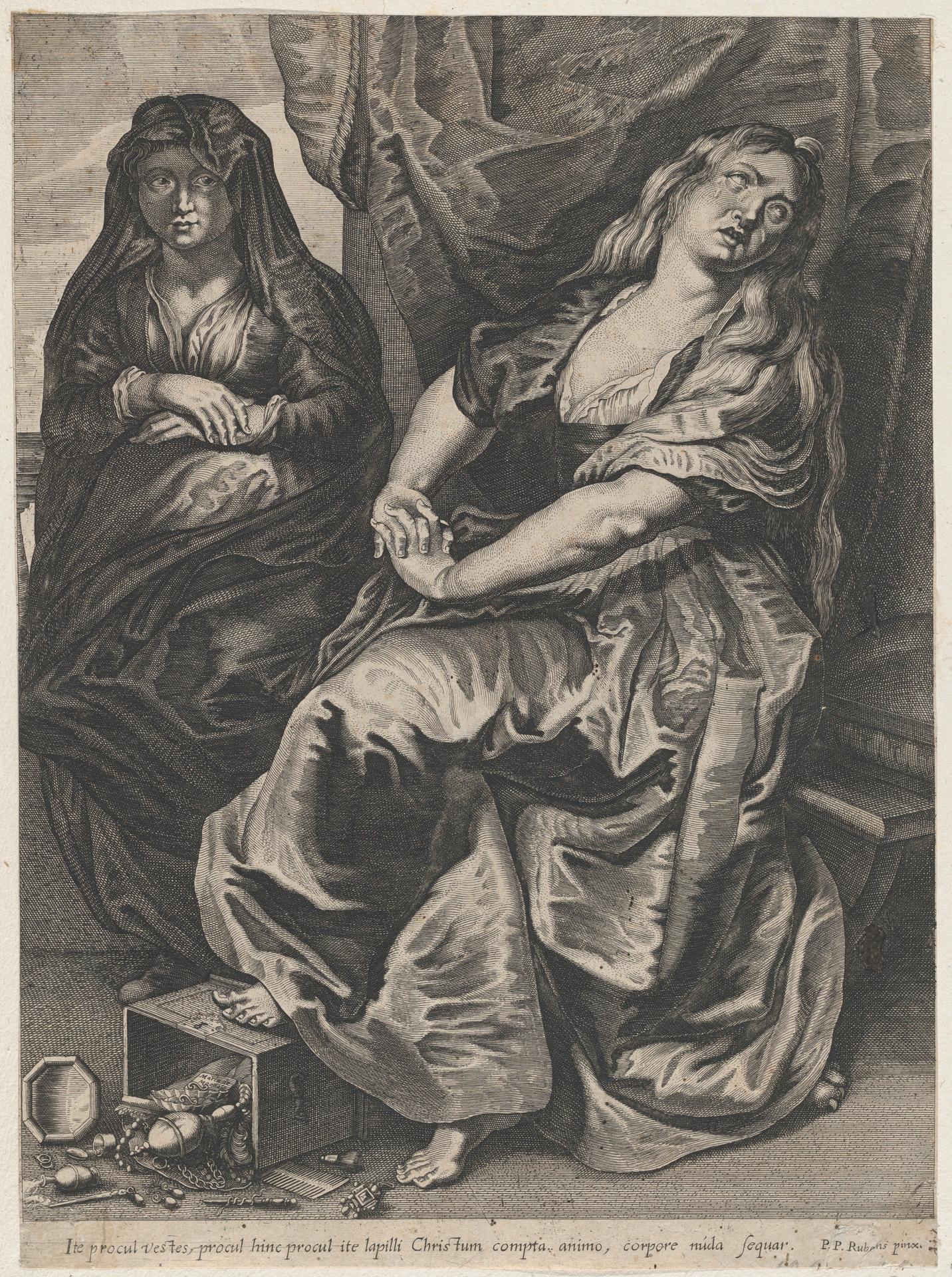
St. Mary Magdalen Trampling Her Valuables (17th–18th century)
Original title: St. Mary Magdalen Trampling Her Valuables
kurzbeschreibung
An unsigned engraving from the 17th or 18th century presents Mary Magdalene as she turns away from her worldly possessions. The saint crouches on the ground, scattered jewels lying around her, and looks back on her former life. The print is a copperplate engraving, a reverse copy of a lost original.
Description
Seated on the ground, head bowed in thought, a woman appears in flowing robes. Long hair falls over her shoulder; beside her stands an open box from which jewellery and personal items have spilled. A dark curtain envelops the scene. The layout feels asymmetrical, with side light modelling shadows and surfaces. Rendered in greys and blacks, the monochrome print is rich in detail.
Context
As a reverse copy, this print reproduces a mirrored version of an earlier work made in the 17th or 18th century. Such copies served in printmaking to circulate well-known compositions. The motif of the penitent Mary Magdalene was highly popular in Catholic art of the Counter-Reformation and stood for the renunciation of worldly goods. Neither the exact origin nor the original engraver is documented.
Impact
The figure's calm demeanour and the gloomy, intimate atmosphere create a contemplative effect. The scattered valuables and the side lighting draw the eye to the saint's face and gesture, inviting reflection on transience.
Technique
Copperplate engraving is a process in which lines are incised into a metal plate and then printed on paper. The reverse copy was made by tracing or printing the original, resulting in a mirror-image reproduction. Fine lines and hatching produce graduated greys and textures.
AI-generated description text
Source: Metropolitan Museum of Art · Public Domain (CC0 1.0)