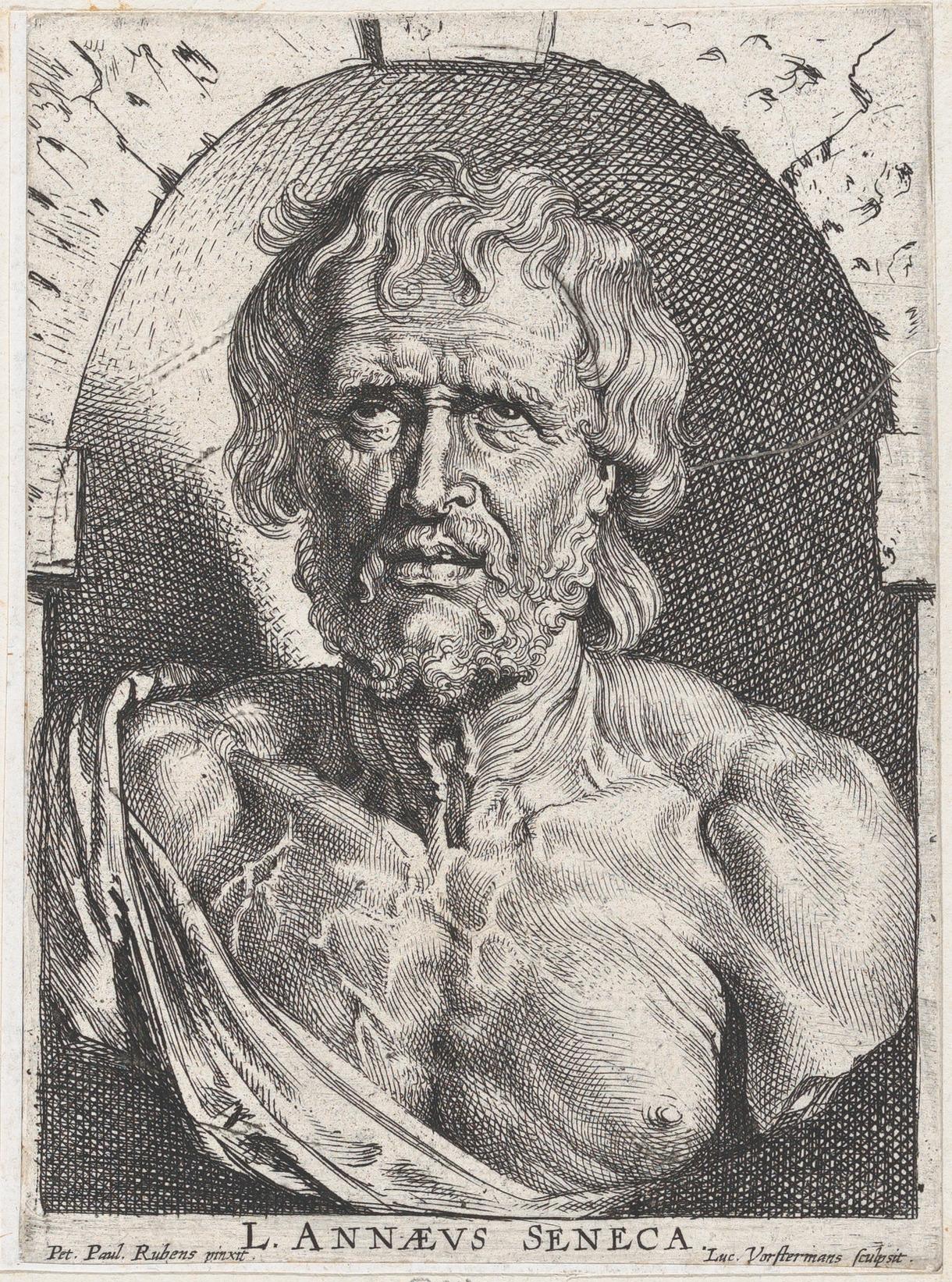
The bust of Seneca, in a niche (ca. 1620, Met-Objekt 1077)
Original title: The bust of Seneca, in a niche
kurzbeschreibung
Around 1620, Lucas Vorsterman I produced an etching with engraving that shows a bust of the philosopher L. Annaeus Seneca in a niche. The design was based on a painting by Peter Paul Rubens. The print measures 13.7 × 10.3 cm and exists in the second of two states.
Description
Inside a shell-shaped niche, the head and upper body of a bearded man with curly hair appear. His gaze is lowered, his expression serious and withdrawn. Fine lines and hatching model the curve of the niche and create a sense of depth. Over his left shoulder lies a piece of cloth that falls in folds. Latin inscriptions at the bottom identify Rubens as the painter and Vorsterman as the engraver.
Context
The work was made in the 1620s, when Rubens ran a large workshop in Antwerp. Vorsterman was among the engravers who translated Rubens's paintings into prints. Seneca, as a Stoic philosopher, was a valued subject in the Renaissance and Baroque periods. The inscription attests to the collaboration between the two artists.
Impact
The pensive expression and the sculptural modeling of the face give the portrait dignity and calm. The niche architecture, with its graded tonal values, opens a space that draws the viewer's gaze inward. The small format demands close, concentrated looking and enhances the intimate effect.
Technique
Etching and engraving complement each other here: the etching provides soft lines for modeling hair and beard, while the burin adds precise hatching for shadows and the cloth. This combination allows a detailed rendering of surfaces. The existence of a second state shows that Vorsterman reworked the plate after the first printing to heighten the effect.
AI-generated description text
Source: Metropolitan Museum of Art · Public Domain (CC0 1.0)