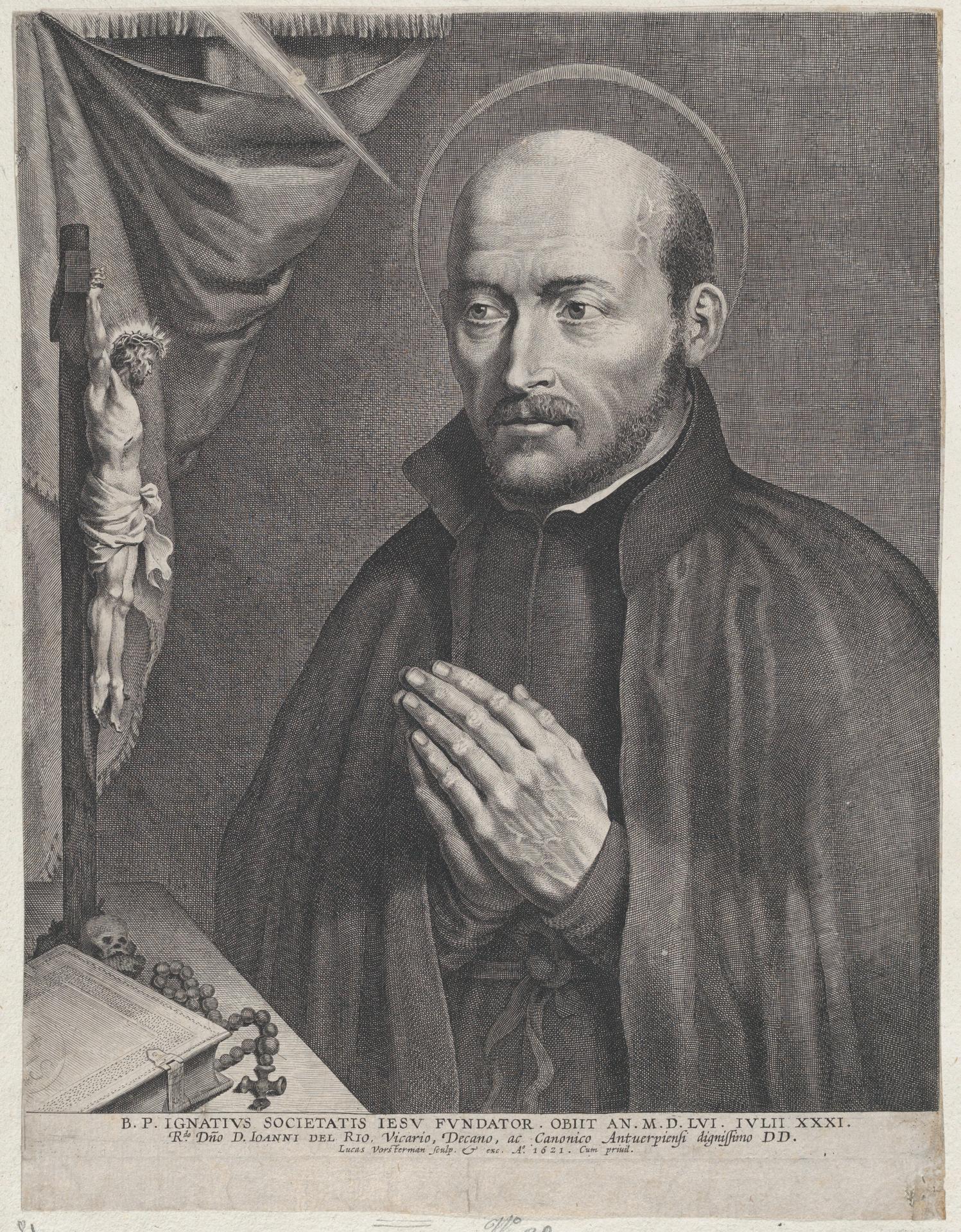
Saint Ignatius of Loyola, praying towards the left with a crucifix, a rosary, a book, and a skull on the table in front of him
Original title: Saint Ignatius of Loyola, praying towards the left with a crucifix, a rosary, a book, and a skull on the table in front of him
kurzbeschreibung
In 1621 Lucas Vorsterman I produced this engraving of Saint Ignatius of Loyola at prayer. Two states of the print are known; this impression belongs to the first. As a devotional image of the early seventeenth century, it served private piety.
Description
With hands folded across his chest, Ignatius kneels and turns to the left. On the table before him lie a crucifix, a rosary, an open book, and a skull. A curtain, partly obscured by a canvas, forms the backdrop. Along the bottom edge runs an inscription with details about the saint and the engraver.
Context
When Lucas Vorsterman I made this print in 1621, he was among Antwerp's leading engravers. Ignatius of Loyola was canonized in 1622; prints like this helped spread his image and devotion. The sheet belongs to the milieu of the Catholic Reformation and the Jesuits, the order founded by Ignatius.
Impact
The arrangement radiates a calm, contemplative atmosphere that invites prayer. Through precise hatching and clear linear definition, the engraving gains dignity and expressive power.
Technique
The engraving was made by cutting lines with a burin into a copper plate and then printing it. The impression measures 32.5 × 26.4 cm and survives in the first of two documented states, suggesting careful reworking by the artist.
AI-generated description text
Source: Metropolitan Museum of Art · Public Domain (CC0 1.0)