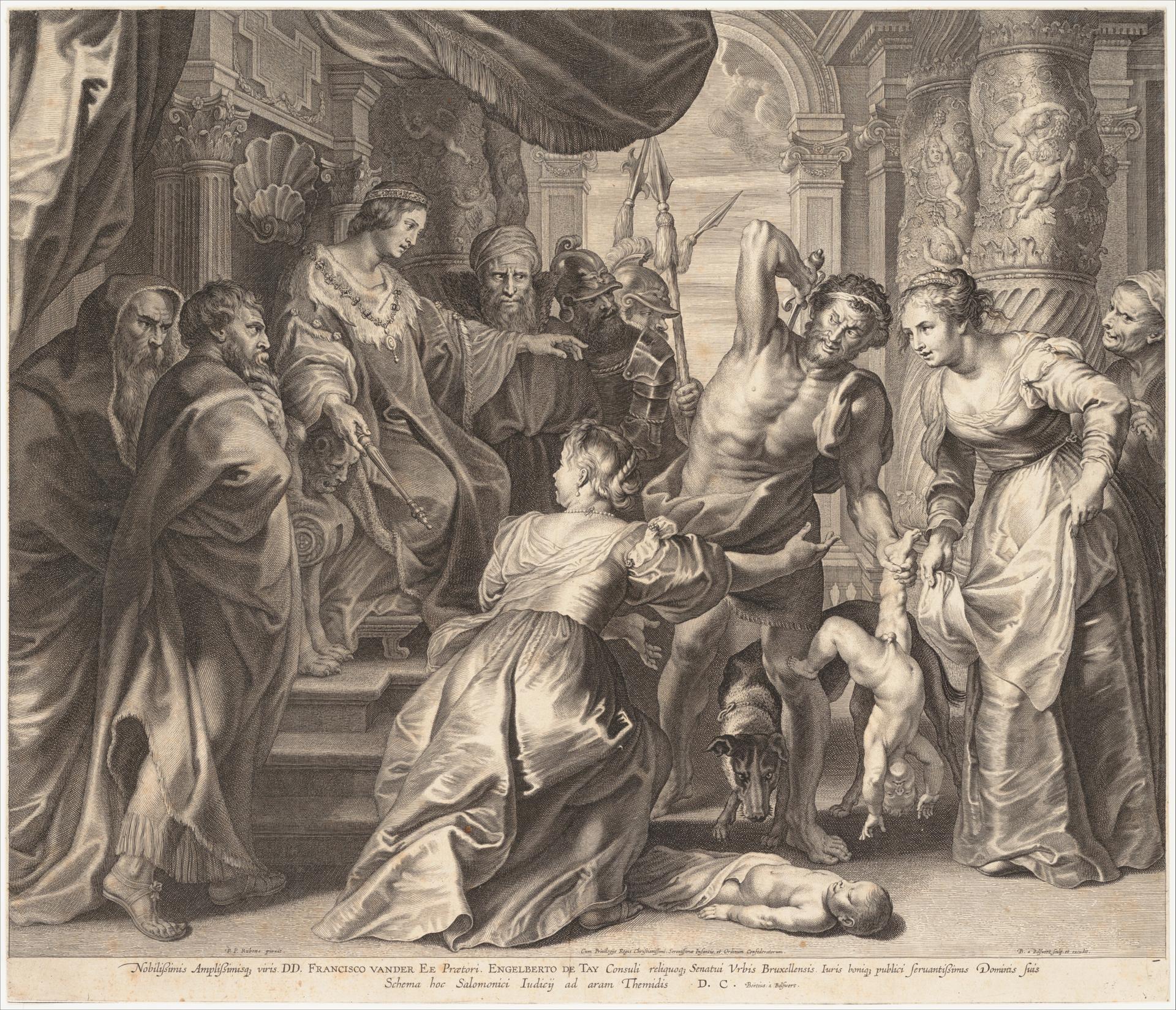
The Judgment of Solomon
Original title: The Judgment of Solomon
kurzbeschreibung
Boetius Adams Bolswert engraved this biblical episode between 1595 and 1633, showing King Solomon deciding which of two women should have custody of a child. The print places the enthroned ruler at its center, with the two mothers, courtiers and soldiers gathered around him to watch the outcome of the trial.
Description
A grand classicizing hall provides the setting. Solomon sits raised in the middle of the image, a sword held aloft in his hand; one woman kneels before him while the other steps forward to confront him. Priests and soldiers line the background and observe the proceedings. The arrangement orders everything symmetrically around the king, with strong contrasts of light and dark that give figures and architecture a sculptural presence. In black and white, the delicate lines and precise detail of garments and columns stand out with particular clarity.
Context
Bolswert, a Flemish engraver of the early seventeenth century, became known above all for his reproductive engravings after paintings by Peter Paul Rubens. At the time this work was made, biblical histories were highly sought after in print, serving both religious edification and the art market. The subject follows the narrative from the First Book of Kings, which was regarded as a model of divine wisdom and justice.
Impact
The balanced layout and Solomon's central position give the sheet a solemn, dignified tone. Clear lines and distinct lighting build a dramatic tension that draws the viewer into the event. The artistic quality is evident in the expressive faces and gestures of those involved.
Technique
For this engraving, the design was cut into a copper plate with a burin. Bolswert used fine parallel lines and cross-hatching to create tonal values and textures. The impression was taken on paper in black, which produces the monochrome effect.
AI-generated description text
Source: Metropolitan Museum of Art · Public Domain (CC0 1.0)