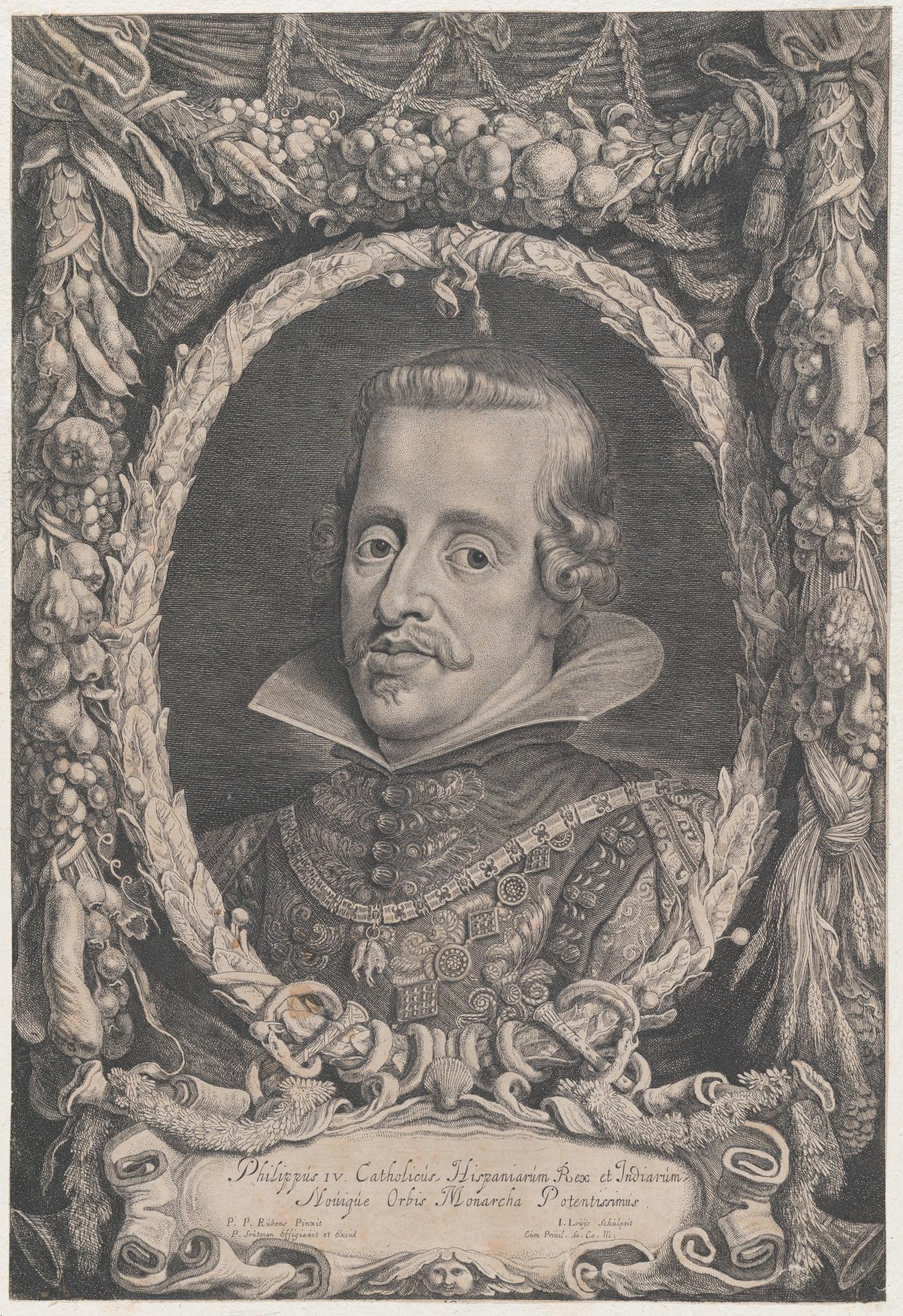
Portrait of Philip IV, King of Spain
Original title: Portrait of Philip IV, King of Spain
kurzbeschreibung
Jacob Louys created this portrait of Philip IV of Spain between about 1615 and 1657 as an etching with engraving. The monarch appears in a precious robe and a collar set with jewels; an ornamental frame of fruits and leaves surrounds him. A Latin text band below gives his name and titles.
Description
Philip IV is placed centrally, his gaze turned slightly to the left. He wears a jewel-encrusted robe and a similarly decorated collar; short, wavy hair, a prominent moustache and a short beard are visible. A dark background makes the bright face stand out, while a symmetrical frame of fruits and leaves encloses the portrait. Along the bottom runs a Latin text band with the inscription 'Philippus IV. Catholicus, Hispaniarum Rex et Indiarum, Novique Orbis Monarcha Potentissimus.' The layout appears clear and symmetrical, executed in monochrome shades of grey and white.
Context
From 1621 to 1665 Philip IV ruled as King of Spain and Portugal. Jacob Louys worked in Antwerp and Paris in the 17th century and produced portraits of European rulers. The print was presumably made on commission or as a reproductive engraving after a painting in order to circulate likenesses of the ruler. The Latin inscription underscores Philip's role as a Catholic monarch and ruler over the New World.
Impact
The symmetrical arrangement and the ornamental frame give the portrait a dignified, representative air. Because the dark background contrasts with the bright face, the eye is drawn to the king's features and emphasises his presence. With its fine lines, the etching creates a detailed, almost ceremonial effect.
Technique
The image was made as an etching, supplemented by engraving; the fine lines and precise shading reveal this. In etching, a metal plate is bitten with acid, creating recesses that are filled with ink and printed on paper. Together, both techniques allow soft transitions as well as clear contours.
AI-generated description text
Source: Metropolitan Museum of Art · Public Domain (CC0 1.0)