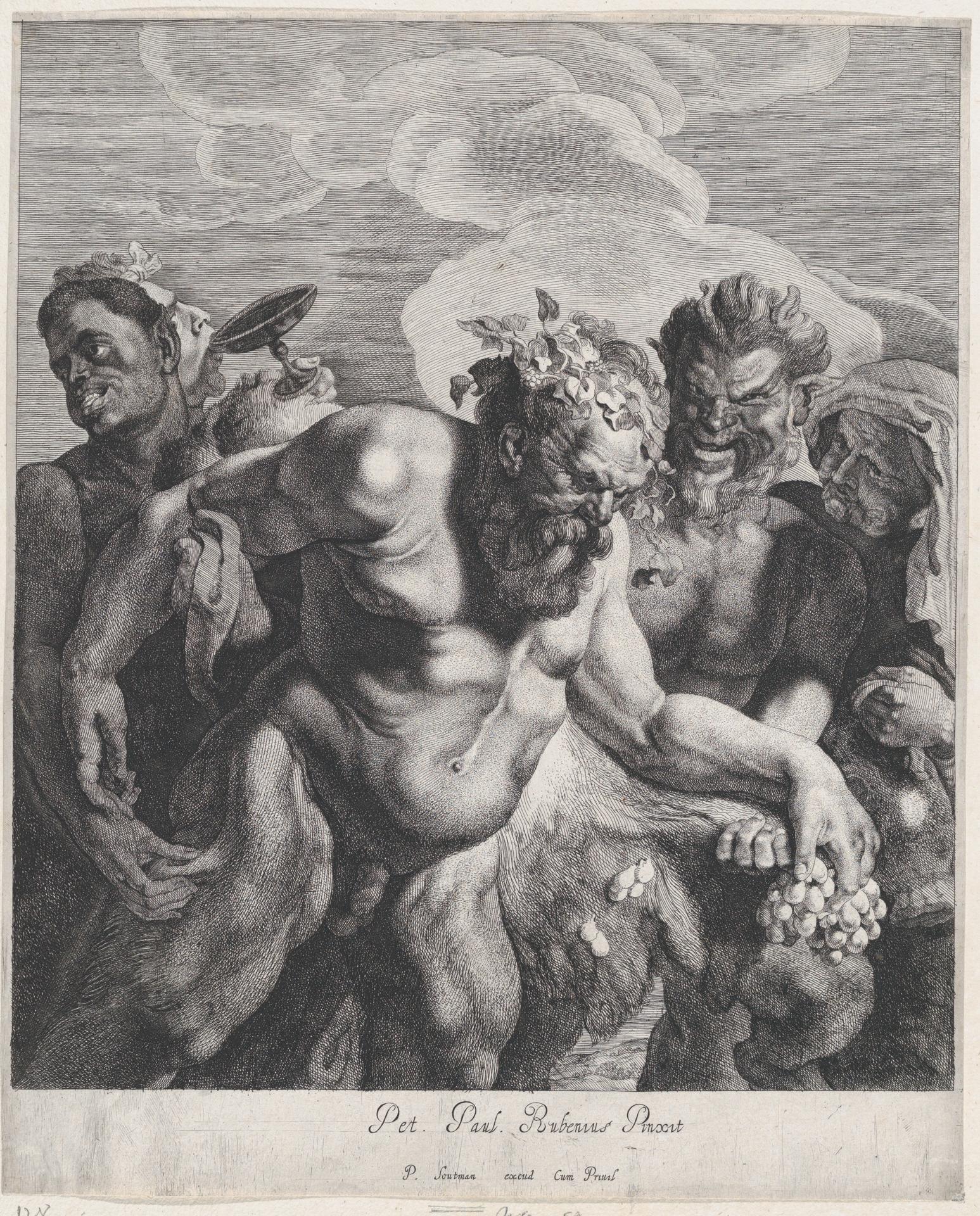
Drunken Silenus
Original title: Drunken Silenus
kurzbeschreibung
Jonas Suyderhoef's print presents a drunken Silen accompanied by a group of figures. Created between 1630 and 1657, the work combines engraving and etching and is the second of five states as recorded by Hollstein.
Description
A burly, half-naked man with a jug steps forward in a dancer's pose. Beside him are other figures—one crowned with a wreath of flowers, another holding a piece of fruit. Above them, the sky opens with clouds, lending the group a mythical air. The bodies are caught in lively motion, the faces expressive, and the irregular spacing of the figures heightens the sense of energy.
Context
Jonas Suyderhoef (c. 1613–1686) was a Dutch engraver who made his name mainly with reproductive prints after well-known painters. His career falls in the Dutch Golden Age, when printmaking was widespread. The drunken Silen, foster father of Dionysus, often appears in Baroque art as a symbol of intoxication and ecstasy.
Impact
The animated figures and dynamic layout make the scene feel immediate. The handling of line creates strong contrasts of light and dark, giving the print dramatic depth. A sensual yet wild mood unfolds, drawing the viewer into the world of myth.
Technique
Engraving and etching are combined here: precise engraved lines alternate with softer, etched passages. This method allows for accurate rendering of musculature and facial features and for subtle gradations of shading. The paper has been trimmed to 34 × 27.7 cm, which makes the arrangement feel dense and concentrated.
AI-generated description text
Source: Metropolitan Museum of Art · Public Domain (CC0 1.0)