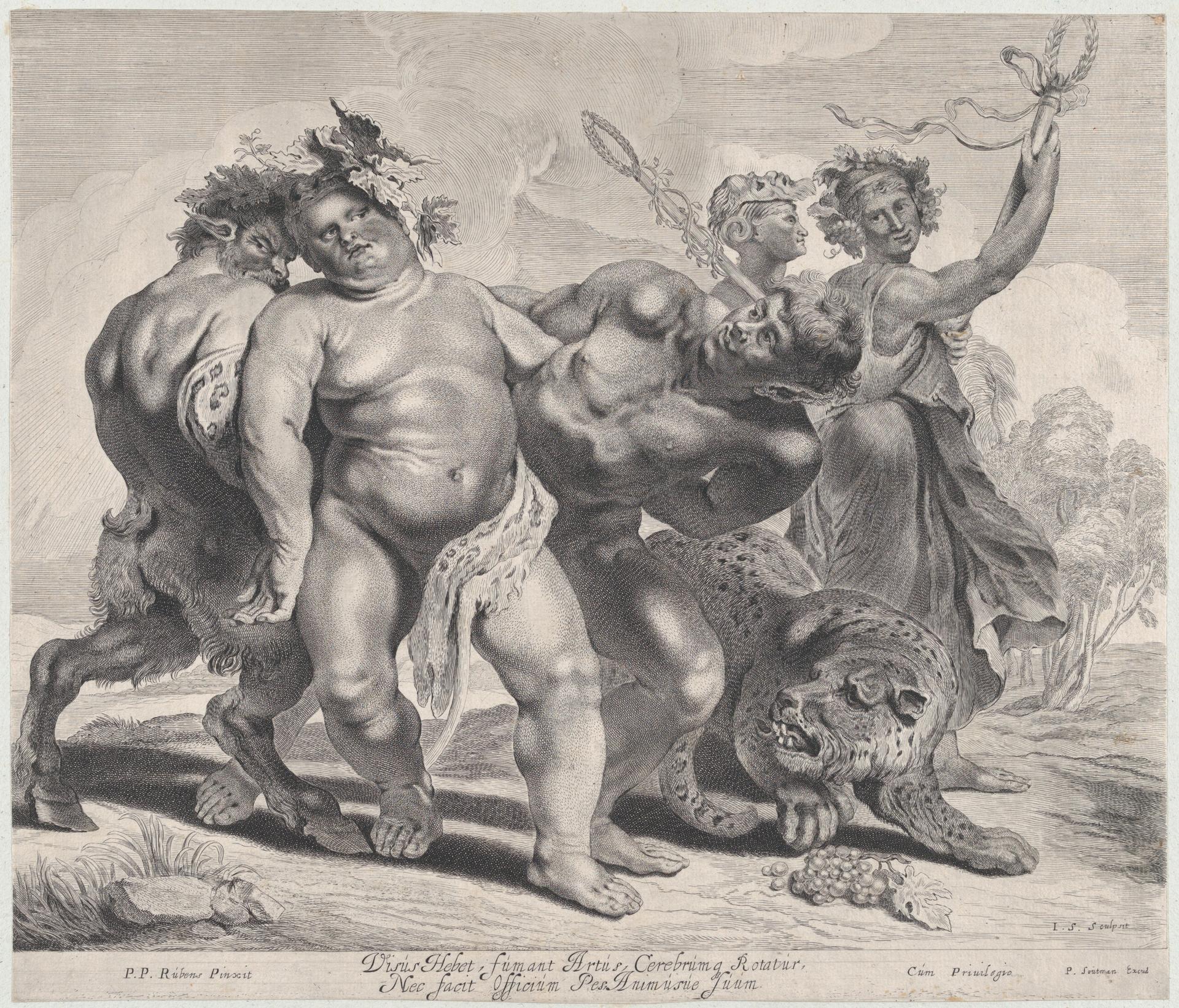
Drunkenness of Bacchus
Original title: Drunkeness of Bacchus
kurzbeschreibung
Peter Paul Rubens's engraving and etching Trunkenheit des Bacchus was made between 1630 and 1657. This black-and-white print uses dense lines and graded shadows to present a turbulent event with powerful male bodies, female figures, and a leopard.
Description
In the foreground, two barefoot, strongly built men grapple: one swings a long, sickle-shaped object while the other parries. A third muscular man, wearing a crown, stands nearby. Further back are two crowned female figures, one holding a band or ribbon. On the ground lie a leopard-like animal, grapes, and leaves; trees and a clouded sky close the view.
Context
In his late phase, Rubens devoted himself more intensely to printmaking. The mythological motif of Bacchus was widespread in the Baroque. The print was produced with engravers who reproduced paintings and designs by Rubens.
Impact
The crowded arrangement of figures and harsh light-dark contrasts give the sheet a dramatic, almost stage-like tension. Precise linework directs the eye to the physical struggle and the wine god's attributes.
Technique
Engraving and etching are combined here, allowing fine lines and deep shadows. This is the first of four states, indicating thorough reworking of the plate.
AI-generated description text
Source: Metropolitan Museum of Art · Public Domain (CC0 1.0)