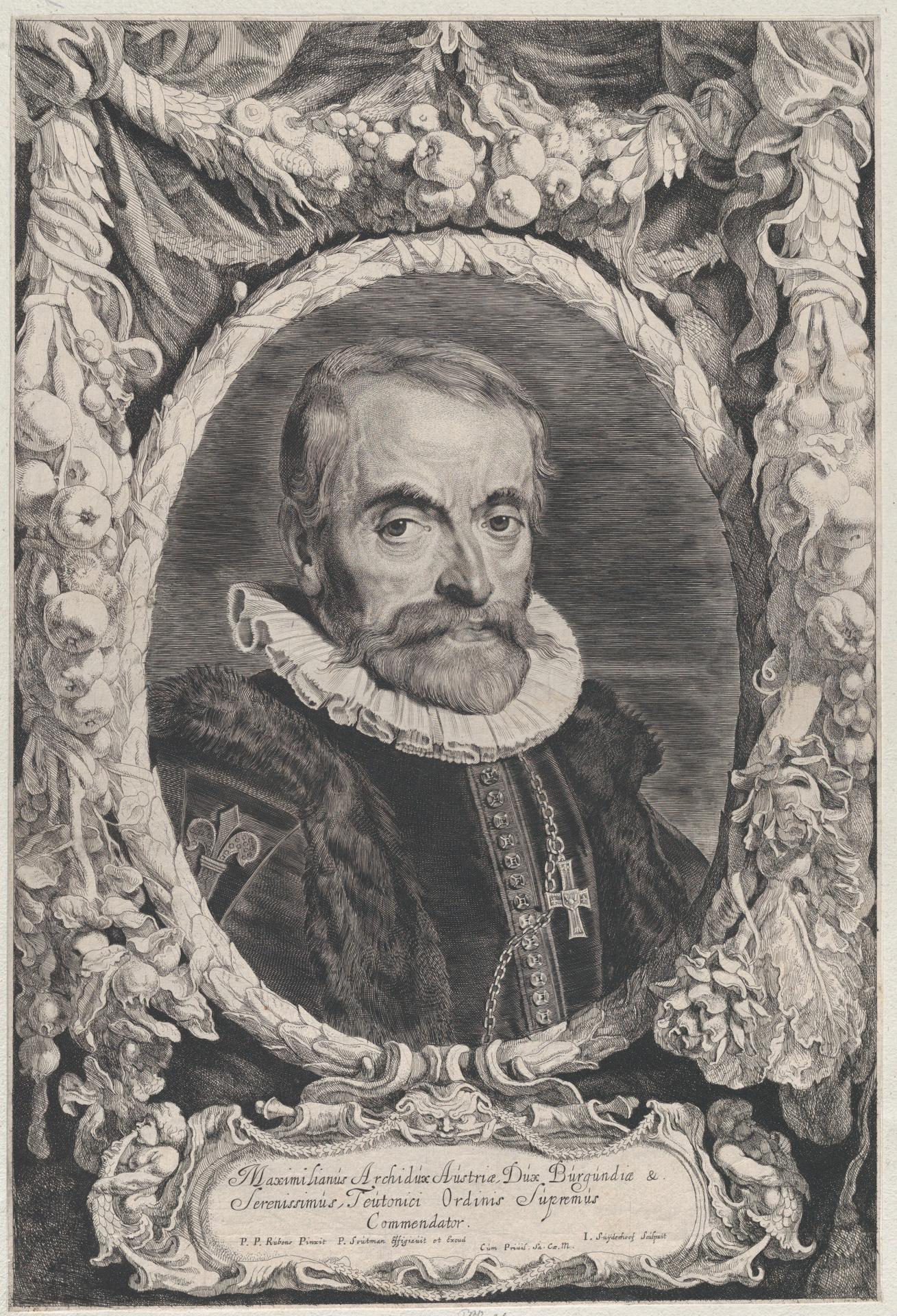
Portrait of Maximilian III, Archduke of Austria (ca. 1650, Met-Objekt 1048)
Original title: Portrait of Maximilian III, Archduke of Austria
kurzbeschreibung
Around 1650, Jonas Suyderhoef combined engraving and etching to portray Maximilian III, Archduke of Austria. The Archduke appears in luxurious garments with fur and a cross pendant, enclosed in an oval frame decorated with floral and fruit motifs. This print is a typical example of Baroque princely portraiture.
Description
Maximilian III is shown within an oval panel bordered by leaf and fruit ornaments. He wears a magnificent robe trimmed with fur, along with a cross pendant and a prominent ruff, as was customary in the 17th century. Below the portrait, a Latin inscription lists the titles and honors of the sitter. The execution remains in shades of gray, with restrained lighting that emphasizes the contours and textures of clothing and background.
Context
Maximilian III held the office of Archduke of Austria and served as Grand Master of the Teutonic Order. His portrait was made around 1650, an era when Baroque art favored princely likenesses to display power and rank—often in the service of diplomatic or dynastic interests. Engraving and etching allowed such portraits to be circulated widely.
Impact
The strict, ordered arrangement and the Archduke's costly attire give the portrait a high degree of representational authority. The oval frame and ornamental decoration create a festive yet dignified feel. The varied linework and soft light produce a calm, elevated mood.
Technique
Executed in engraving and etching, the process allows precise reproduction of even the finest details. The limitation to shades of gray and nuanced lighting enhance the three-dimensional appearance of fabrics and decorative forms. The present work is the first of two states, suggesting careful working and subsequent reproduction of the portrait.
AI-generated description text
Source: Metropolitan Museum of Art · Public Domain (CC0 1.0)