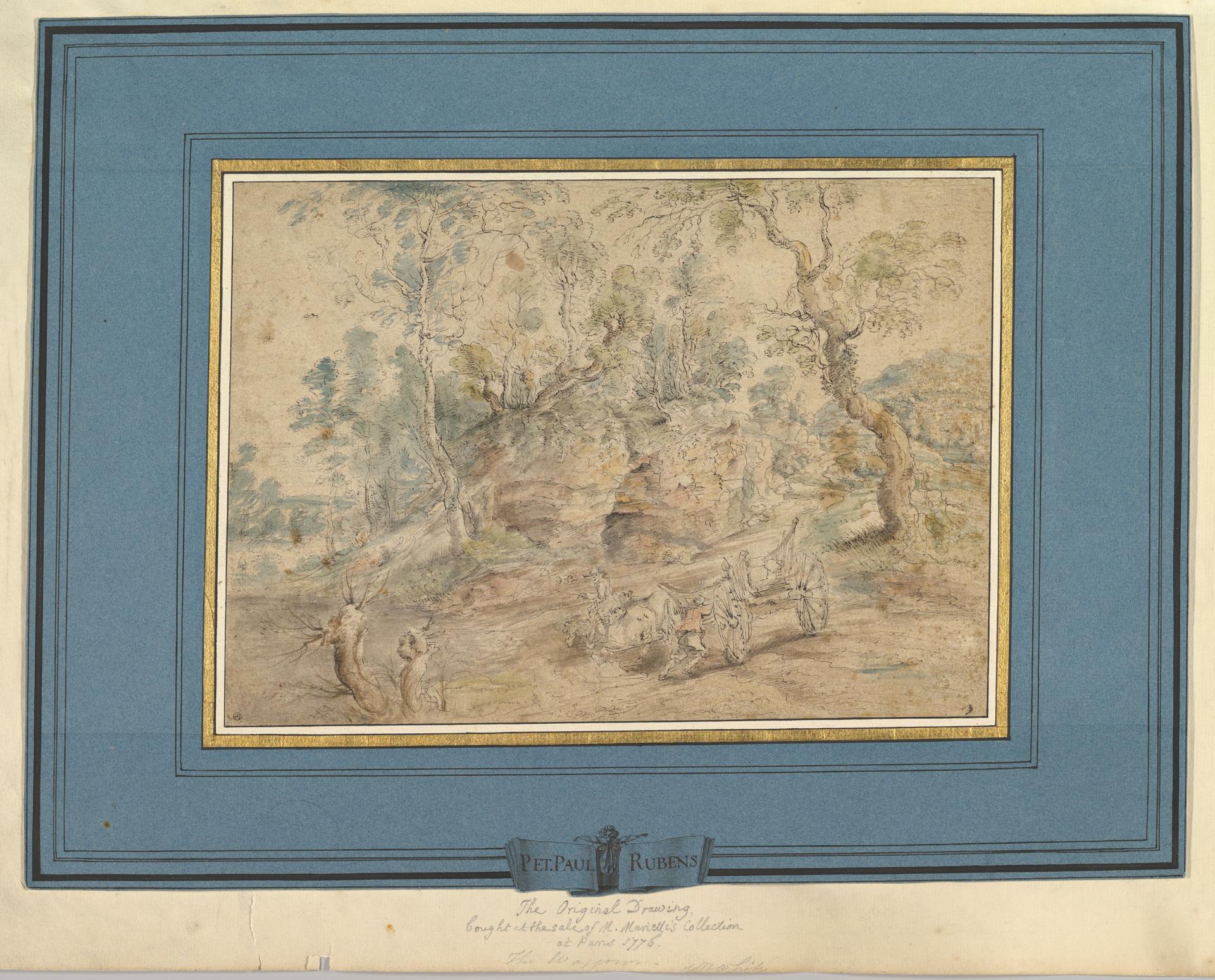
The Wagonner
Original title: The Wagonner
kurzbeschreibung
Lodewijk de Vadder, a Flemish landscape painter from Antwerp, made this scene of a horse-drawn cart in a landscape around 1620. Executed in watercolor, graphite and black ink on paper, the sheet measures 22 x 29.3 cm.
Description
A horse-drawn cart crosses an expansive landscape; trees and rocks step the space back in layers. The small, detailed figures suggest a historical event. Blues and greys dominate the restrained palette, which recalls a pencil drawing. Diffuse light gives the view a calm mood, as if it were early morning or late afternoon. The style feels realistic with a romantic touch, carried by gentle coloring and precise observation of nature.
Context
Lodewijk de Vadder, a 17th-century Flemish landscape painter, was active in Antwerp. His naturalistic landscapes are often inspired by the surroundings of that city. This sheet was made during a heyday of Flemish landscape painting, shaped by artists such as Rubens and the development of a realistic approach to landscape. Watercolor and graphite were among the common techniques for studies and sketches at the time.
Impact
The muted colors and diffuse light create a quiet, contemplative atmosphere. Realistic traits with a romantic overtone invite you to immerse yourself in the landscape and discover details. The small figures keep their distance and thus emphasize the vastness of nature.
Technique
Watercolor, graphite and black ink on paper come together. The graphite allows fine, precise lines, while the watercolors provide soft transitions and the restrained palette. The black ink likely accents contours and individual details, giving the sheet structure and additional depth.
AI-generated description text
Source: Metropolitan Museum of Art · Public Domain (CC0 1.0)