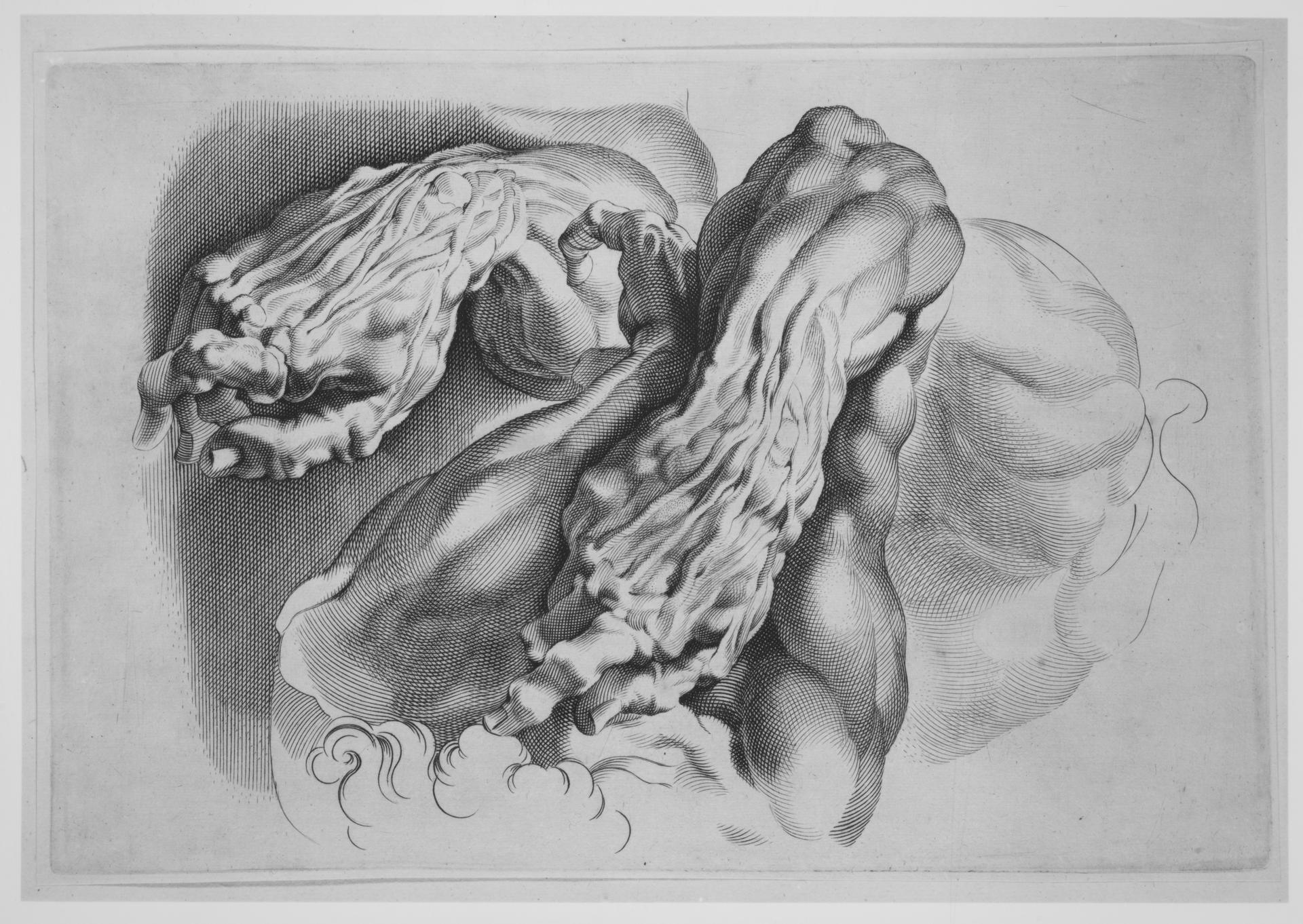
Three Studies of Écorchés
Original title: Three Studies of Écorchés
kurzbeschreibung
Three anatomical studies with exposed musculature appear in this engraving by Paulus Pontius, made after 1640. The figures, rendered as écorchés, are arranged in lively poses.
Description
Muscles and tendons stand out sharply, and the three bodies stretch across the entire frame in a flowing, dynamic pose. Folds and muscle structure emphasize the movement. A bare background makes the figures stand out in the foreground. The color scheme is monochromatic with various shades of gray, created by hatching and lines. The light appears even, without strong shadows or highlights.
Context
Paulus Pontius, a Flemish engraver, worked closely with Peter Paul Rubens. This print was made after 1640, possibly as a reproduction after a painting or drawing by Rubens, who was known for his anatomical studies. Such écorché depictions served artists as study material for rendering the human body.
Impact
The precise anatomical rendering conveys a factual, scientific effect that remains aesthetically appealing through the animated poses. The monochromatic graphic directs the eye to the muscle structure and gives the sheet a timeless clarity.
Technique
In engraving, lines are incised into a copper plate and then printed. Fine hatching and lines create the gray tones and the detailed reproduction of the anatomy. The plate measures 31.3 x 20.8 cm, the sheet 32 x 21.4 cm.
AI-generated description text
Source: Metropolitan Museum of Art · Public Domain (CC0 1.0)