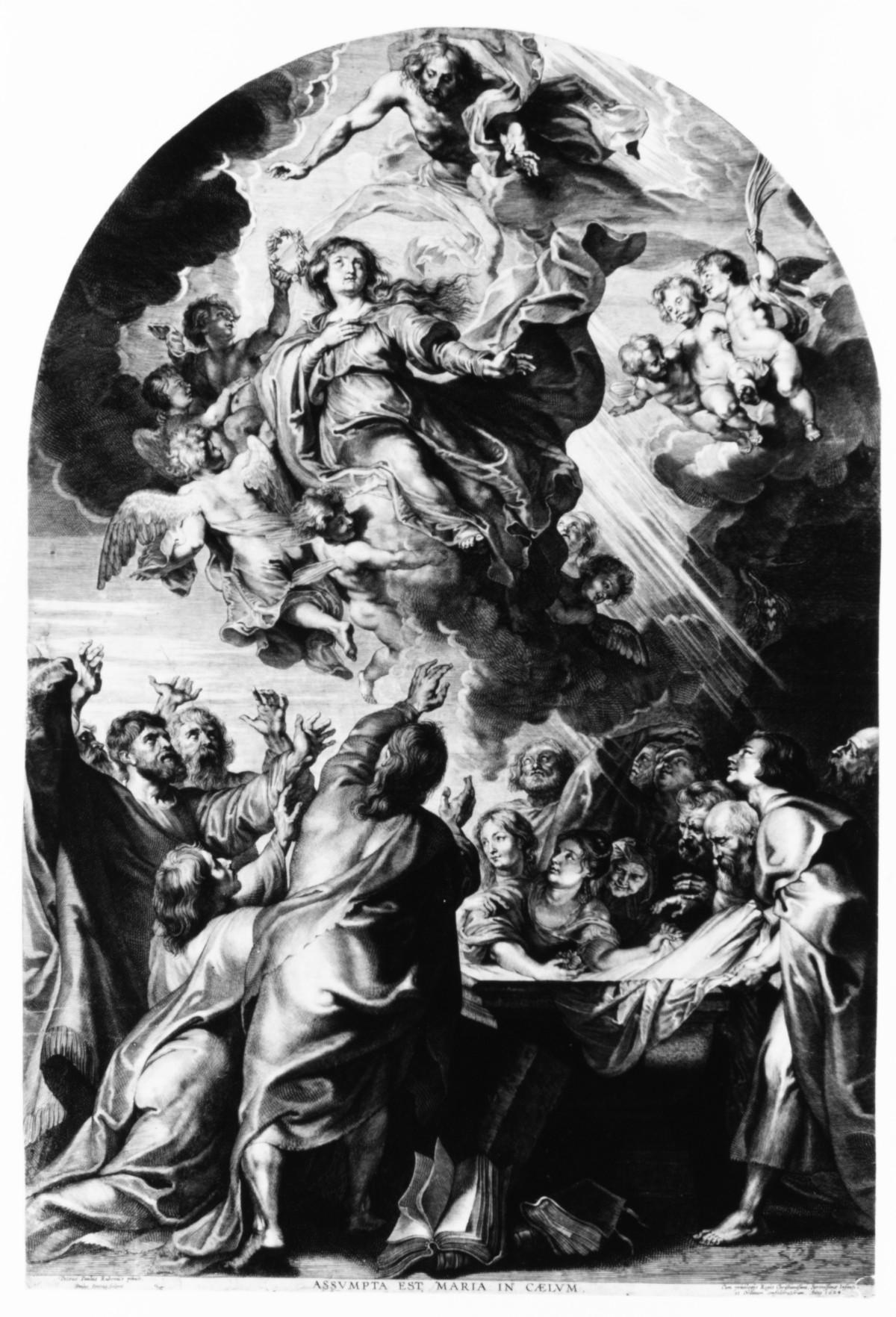
Assumption of the Virgin (1624)
Original title: Assumption of the Virgin
kurzbeschreibung
Paulus Pontius produced this engraving, the Assumption of Mary, in 1624. It belongs to the Baroque print tradition and captures the Virgin's rise into heaven through lively, sweeping lines. The sheet is upright and finishes in a rounded arch.
Description
Mary floats upward, lifted by a host of angels who guide her aloft. Her hands are raised, and one angel supports her. Below, several figures respond with outstretched arms. The layout is strictly vertical, reinforcing the upward movement; black-and-white lines create spatial depth through contrasts of light and dark.
Context
Paulus Pontius, a Flemish Baroque engraver, worked closely with Peter Paul Rubens. He made this print in 1624, when the Catholic Counter-Reformation gave special support to Marian subjects. The Assumption of Mary was a central motif in Catholic iconography and widely seen in Flanders.
Impact
The dynamic arrangement and expressive gestures stir strong emotional tension. The vertical pull draws the eye upward, so the heavenly realm feels overwhelming and sublime. Fine hatching animates the surface and heightens the drama of the moment.
Technique
In engraving, lines are cut into a metal plate and then printed. Precisely placed lines and hatching allow a detailed rendering of light and shadow, characteristic of seventeenth-century printmaking. The upright format with an arched top matches the usual design for sacred prints of the period.
AI-generated description text
Source: Metropolitan Museum of Art · Public Domain (CC0 1.0)