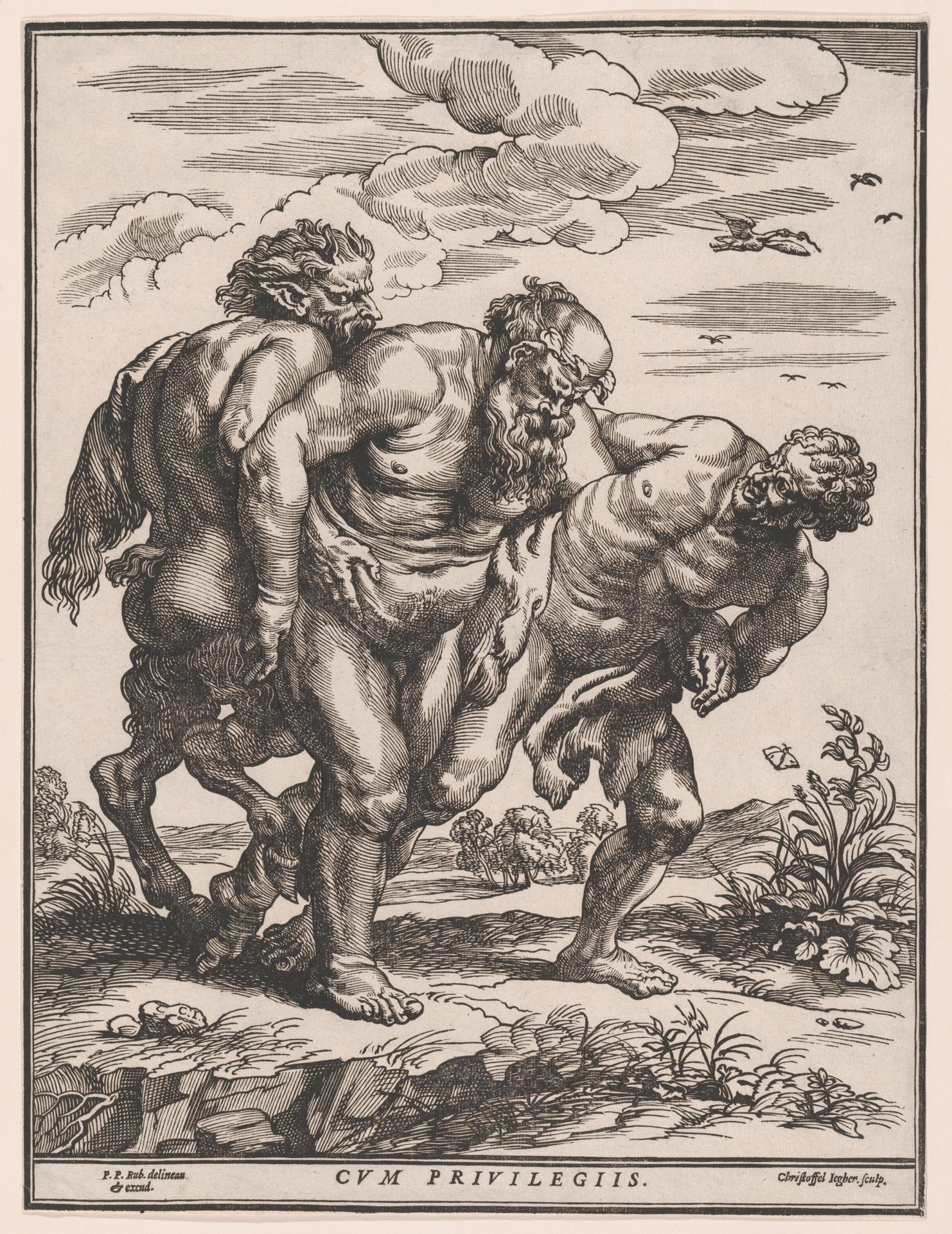
The March of Silenus
Original title: The March of Silenus
kurzbeschreibung
Christoffel Jegher produced the woodcut "The March of Silenus" around 1652. Three sturdy, bearded figures stride through a landscape with lively movement. The design came from Peter Paul Rubens, as the inscription "P. P. Rub. delineau & excud." at the bottom edge of the sheet indicates.
Description
Three muscular, bearded men advance to the right in a loose group. The middle figure surpasses the other two in height and bulk, and his companions follow him. Clouds hang above the scene, with a few birds flying in the sky. Bushes, grasses, and a small stream structure the landscape space. The woodcut remains black and white; the linework brings out contours and shading.
Context
Around 1652 Jegher was working in Antwerp as a woodcutter, where this sheet was made. Rubens, who supplied the design, was no longer alive at the time, but his workshop and style continued to influence printmaking. Jegher cut several works after the master's designs, which were prized for dramatic movement and mythological subjects. The motif of Silenus, a companion of Dionysus, was very popular in Baroque art, as it combined nature, intoxication, and myth.
Impact
The muscular bodies and dynamic poses give the image strength and movement. Thanks to the clear lines of the woodcut, the mythical narrative gains graphic sharpness and becomes emphatically vivid.
Technique
For this woodcut, the motif was cut into a wooden block and then printed onto paper. Jegher used fine and bold lines to achieve effects of light and shadow, as was characteristic of seventeenth-century woodcut art.
AI-generated description text
Source: Metropolitan Museum of Art · Public Domain (CC0 1.0)