Pompa Introitus...Ferdinand, Austriaci. Antwerp
Original title: Pompa Introitus...Ferdinand, Austriaci. Antwerp
kurzbeschreibung
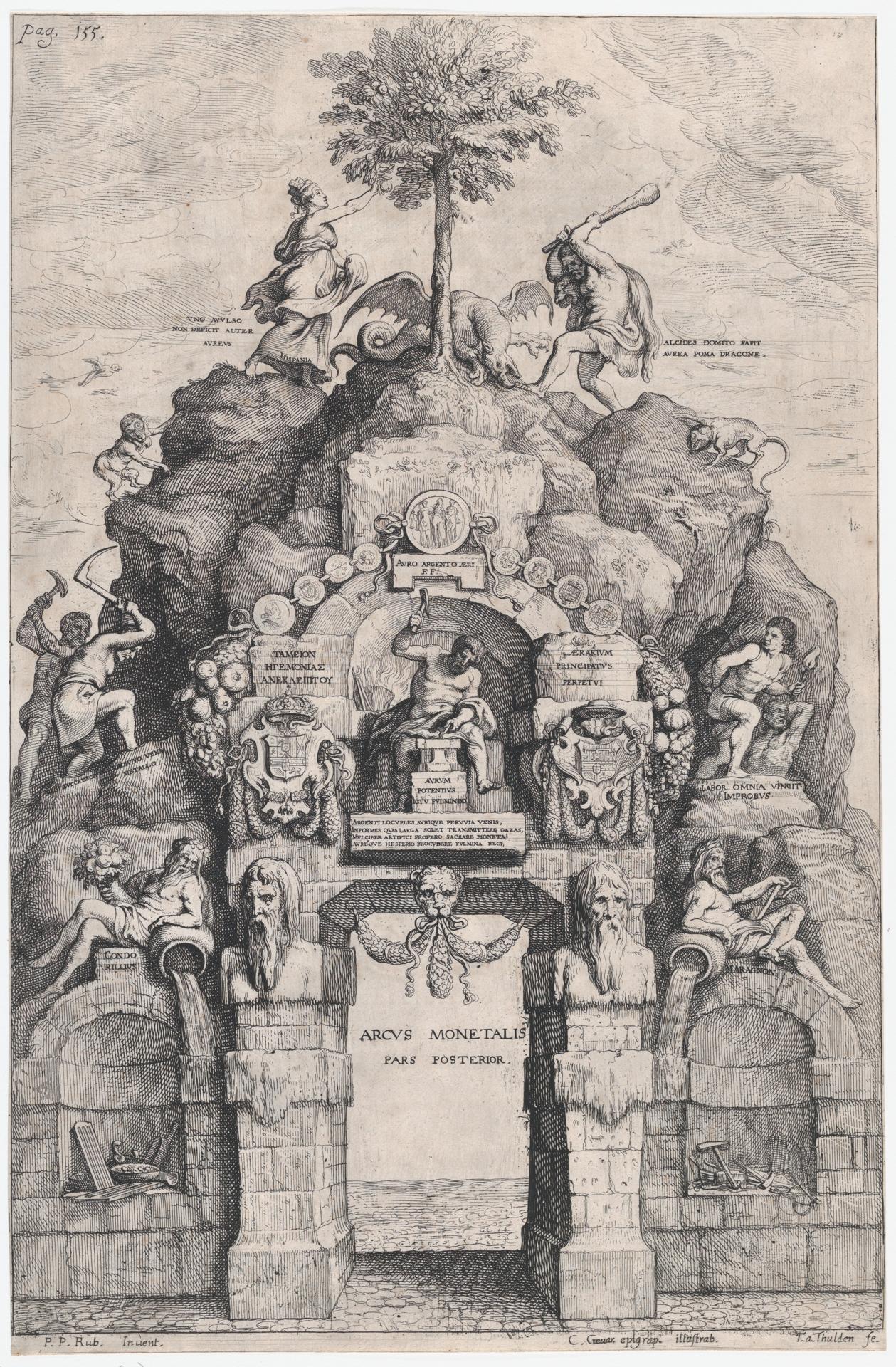
A monumental triumphal arch, known as the 'Arcus Monetalis Pars Posterior', takes centre stage in this 1635 etching by Peter Paul Rubens. The print belongs to a series that records the festive entry of Cardinal-Infante Ferdinand of Austria into Antwerp. Architecture and mythological figures, along with animals, come together in a symmetrically balanced image.
Description
Two figures pour water from shallow bowls, framing a large arch supported by columns. Above them, seated on a rocky outcrop, is a female figure holding a fruit; beside her stands a man with a hammer. A wolf and a dog appear between them, while further back other people busy themselves with tools. A densely leafy tree crown rises above the scene. The etching is rendered in graduated greys with clear, fine lines.
Context
Created for the ceremonial entry of Cardinal-Infante Ferdinand of Austria into Antwerp in 1635, for which Rubens served as artistic director of the festivities. The 'Pompa Introitus' series preserves the ephemeral triumphal arches and temporary structures of that event. Rubens provided the designs, which were executed by various engravers; exactly who is responsible for this etching remains uncertain.
Impact
Clear lines and a symmetrical layout give the print a monumental character. The interplay of architecture and mythological figures creates a festive, ceremonial mood that suits the occasion of a ruler's entry.
Technique
The etching was made by biting a metal plate with acid, with Rubens supplying the pictorial design. This technique allows for fine, even lines and precise reproduction of details, as seen in the figures and the arch. Printing was in monochrome greys, as is customary for etchings.
AI-generated description text
Source: Metropolitan Museum of Art · Public Domain (CC0 1.0)