Fall of the Giants
Original title: Fall of the Giants
kurzbeschreibung
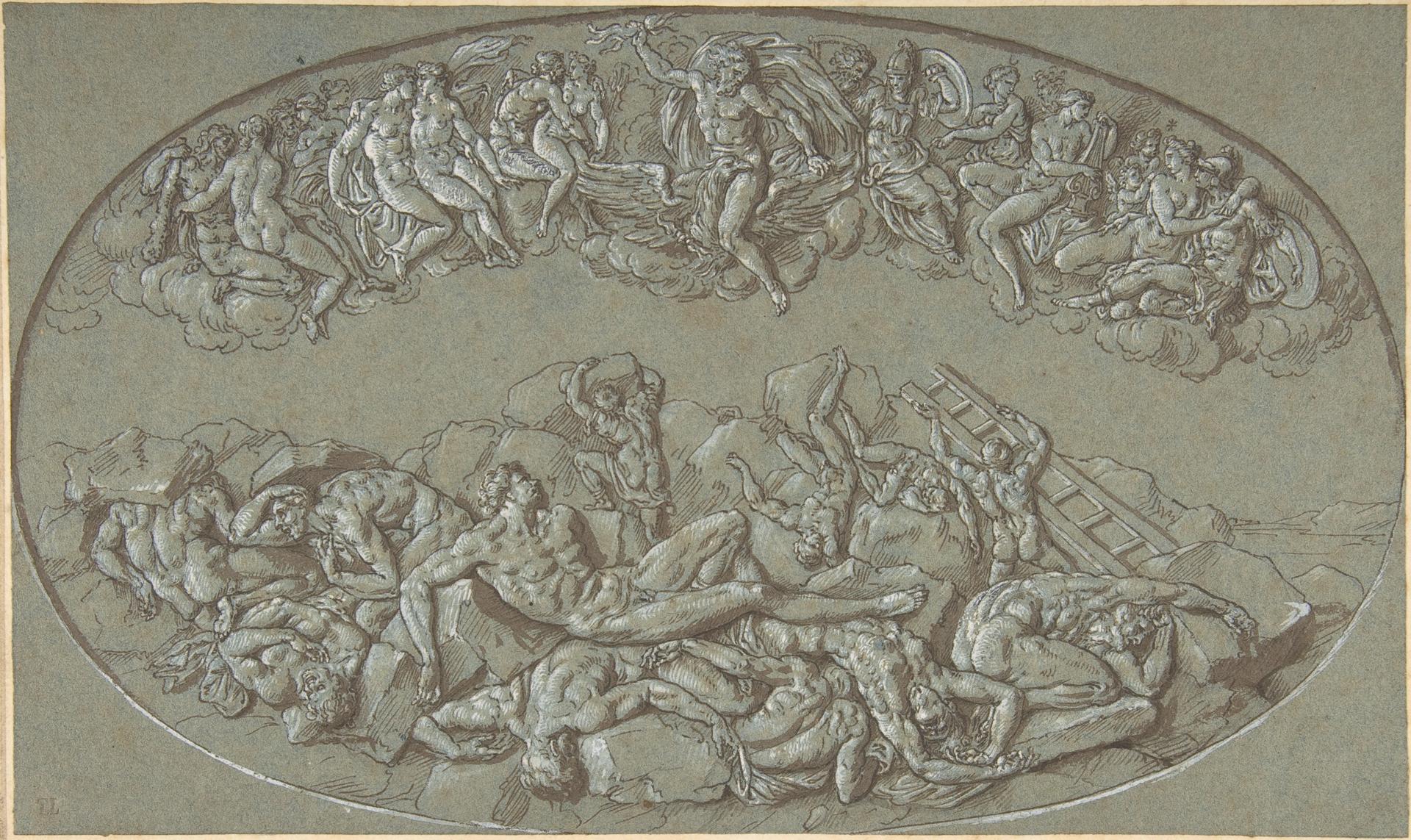
A tangle of falling and hovering figures fills Bernard Picart's 'Fall of the Giants,' drawn at the turn of the 18th century. Pen and brown ink, brown wash, and white heightening on blue paper turn the Greek myth of the Giants' downfall into a layered scene teeming with movement.
Description
Wreaths and weapons mark the floating, partly clothed figures above as a triumphant procession. Below them, mostly naked bodies fight or lie fallen, some wounded, others exhausted. The arrangement is asymmetrical and strongly vertical: the upper figures hover higher and more fluidly, while those below cling heavily to the ground. Brown tones dominate, with delicate light and pronounced shadows modeling the bodies.
Context
Bernard Picart (1673–1733), a French engraver and draughtsman, was known for mythological and historical scenes. This sheet belongs to an era when the Baroque favored such subjects. Picart worked in Amsterdam, where he earned renown for biblical and mythological depictions. The drawing shows his ability to capture complex groups of figures with great precision.
Impact
Hovering victors above defeated figures on the ground—this contrast creates drama and dynamism. The oval shape and vertical emphasis focus the eye on the central conflict. Restrained lighting and clear contours give the sheet a Baroque theatricality.
Technique
Pen and brown ink, brown wash, and white heightening on blue paper—this combination allows precise lines and rich tonal gradations. The blue paper deepens the shadows and makes the white highlights stand out.
AI-generated description text
Source: Metropolitan Museum of Art · Public Domain (CC0 1.0)