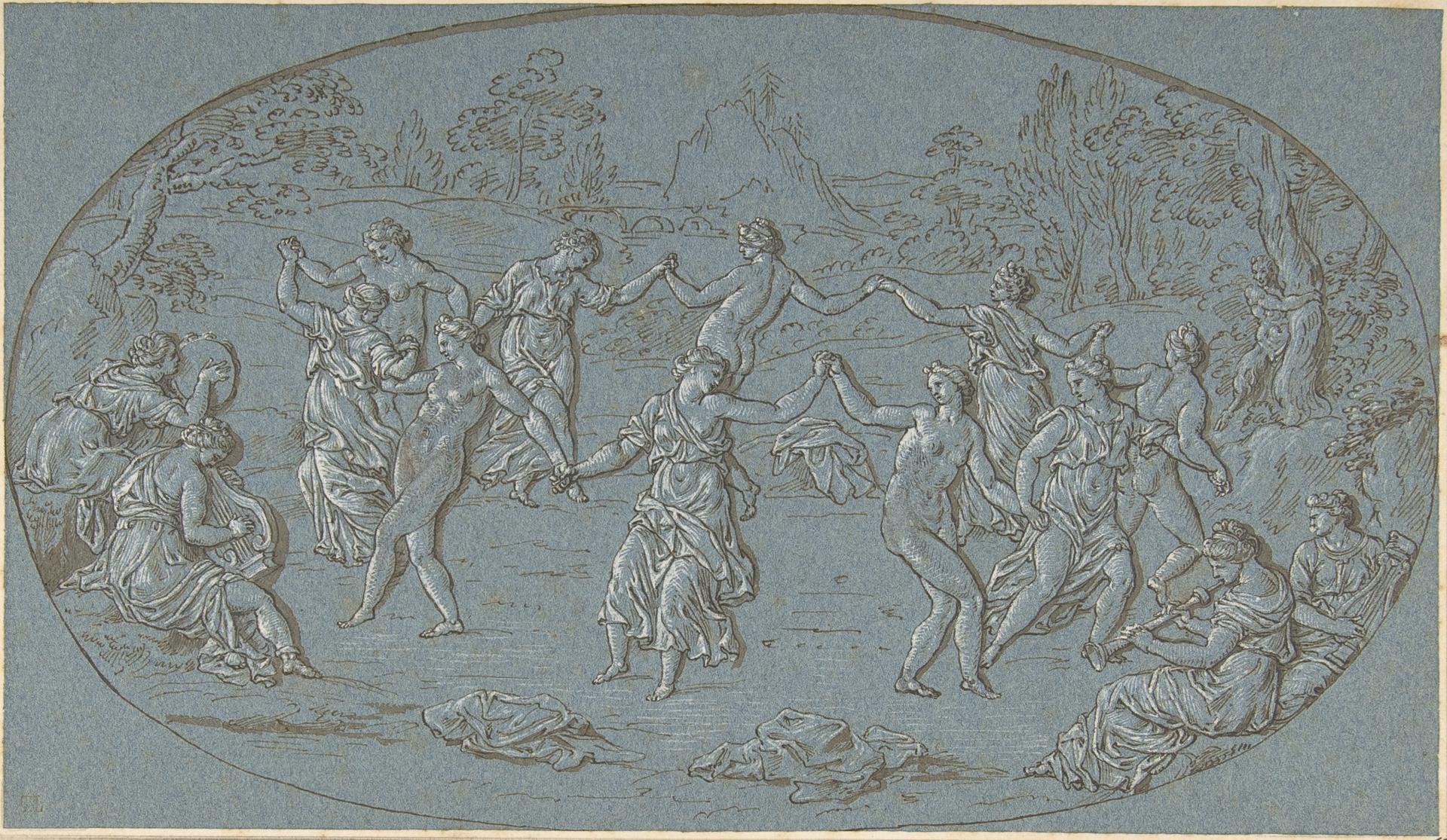
Dancing Nymphs in a Glade
Original title: Dancing Nymphs in a Glade
kurzbeschreibung
Bernard Picart made this drawing, Dancing Nymphs in a Clearing, between the late 17th and early 18th centuries. Pen and brown ink, brush and brown wash, and white heightening on blue paper; the sheet measures 16.1 by 27.5 cm. It portrays a group of dancing figures in an idyllic woodland setting.
Description
The figures settle into an oval arrangement that lets the eye glide through the image. Some dance, while others remain seated or standing; their garments range from plain to more elaborate. Trees, a landscape, and a river close off the distance. Gray tones dominate the palette, while the blue paper's hue underscores the scene. Light appears even and shadowless, suggesting an idealized approach.
Context
Bernard Picart (1673–1733) worked as a French engraver and draftsman, best known for his book illustrations. This sheet belongs to an era when mythological and arcadian subjects were in demand in European art. For a time, Picart was active in Amsterdam for publishers. Nymphs and rural festivities draw on the pastoral tradition that was widespread in 17th-century France and the Netherlands.
Impact
The drawing feels cheerful and almost bucolic, carried by the oval group of figures and the quiet landscape. Brown tones and blue paper form a harmonious contrast that makes the image lively yet calm. The layout guides the eye gently, without dramatic emphasis.
Technique
Pen and brown ink were used, along with brush and brown wash for shading. White heightening accents garments and body parts. The blue paper serves as the underlying tone, bringing together the brown and white values and giving the sheet a cool, detached effect.
AI-generated description text
Source: Metropolitan Museum of Art · Public Domain (CC0 1.0)