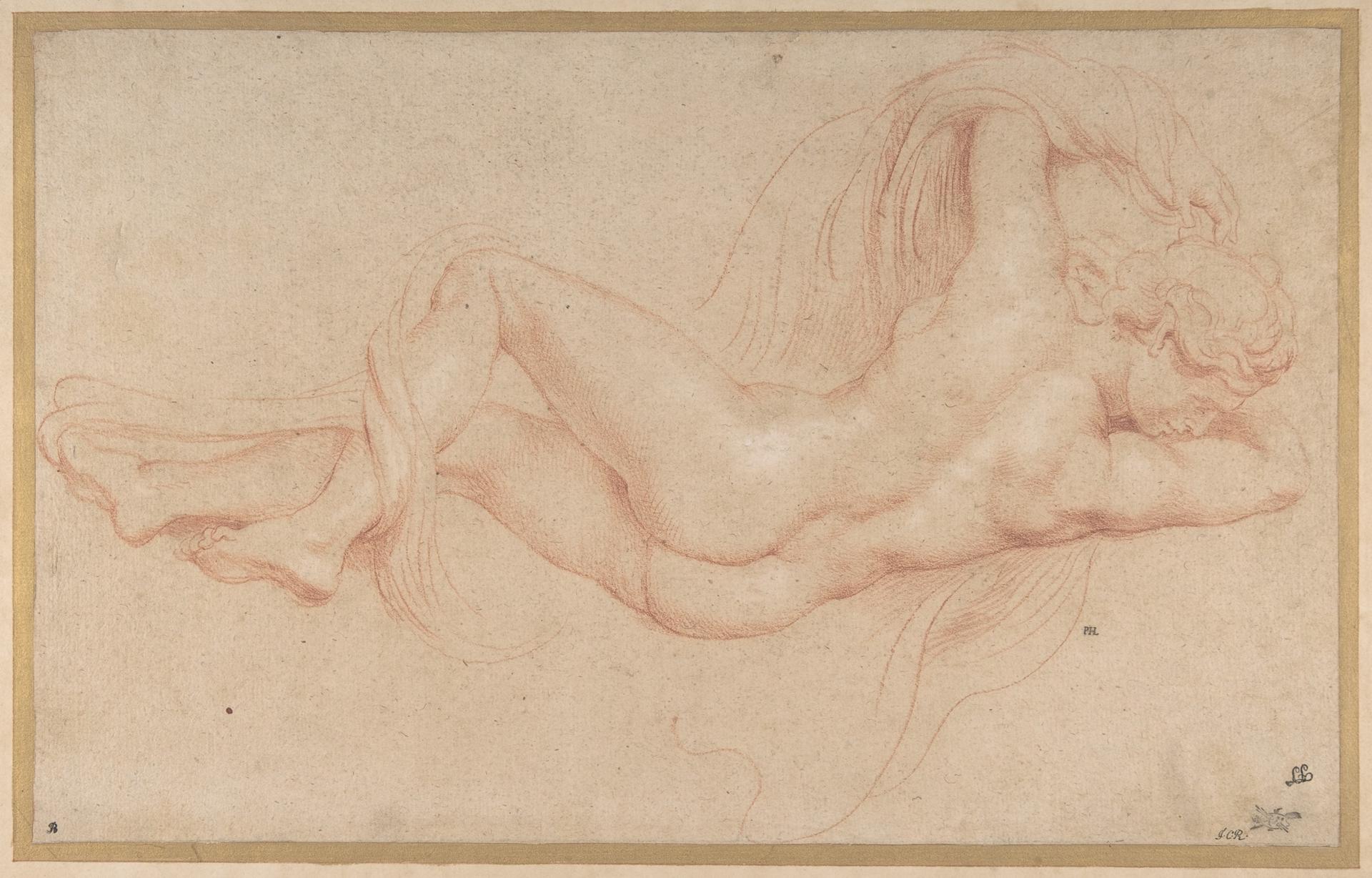
Hermaphrodite
Original title: Hermaphrodite
kurzbeschreibung
Unlike many related nude studies, Peter Paul Rubens's 'Hermaphrodite' from the 17th century focuses on a reclining male body, captured in red chalk with white heightening. The subject comes from Greek mythology: a figure that combines both male and female features.
Description
What we see is a reclining male body, with the right arm resting above the head and the left extended downward. The legs are slightly apart, and the face turns to the left; the hair and facial features are rendered in detail. The overall arrangement remains plain, directing attention entirely to the body and its pose; the coloring derives essentially from the paper and the drawing materials. A small monogram appears at the lower right, and the sheet has a brown border.
Context
Rubens made this drawing as a study after an antique model, probably during his stay in Italy (1600–1608), when he was deeply engaged with classical sculpture. The hermaphrodite was a popular motif in antiquity and the Renaissance, one that negotiated the union of the sexes. The sheet likely served as a preparatory study for a larger painting or as an independent study sheet in the workshop.
Impact
The sheet feels sensual and at the same time powerful; red chalk and white heightening give the body a lively three-dimensionality. The reclining pose and restrained modeling create a calm, contemplative mood that invites the viewer to take in the androgynous beauty.
Technique
For the nude, Rubens used red chalk (sanguine) and white heightening on paper. The red chalk technique allows for fine shading and soft transitions, while the white heightening adds highlights and emphasizes the body's plasticity. The sheet is mounted on paper with a brown border, which suggests later framing or storage.
AI-generated description text
Source: Metropolitan Museum of Art · Public Domain (CC0 1.0)