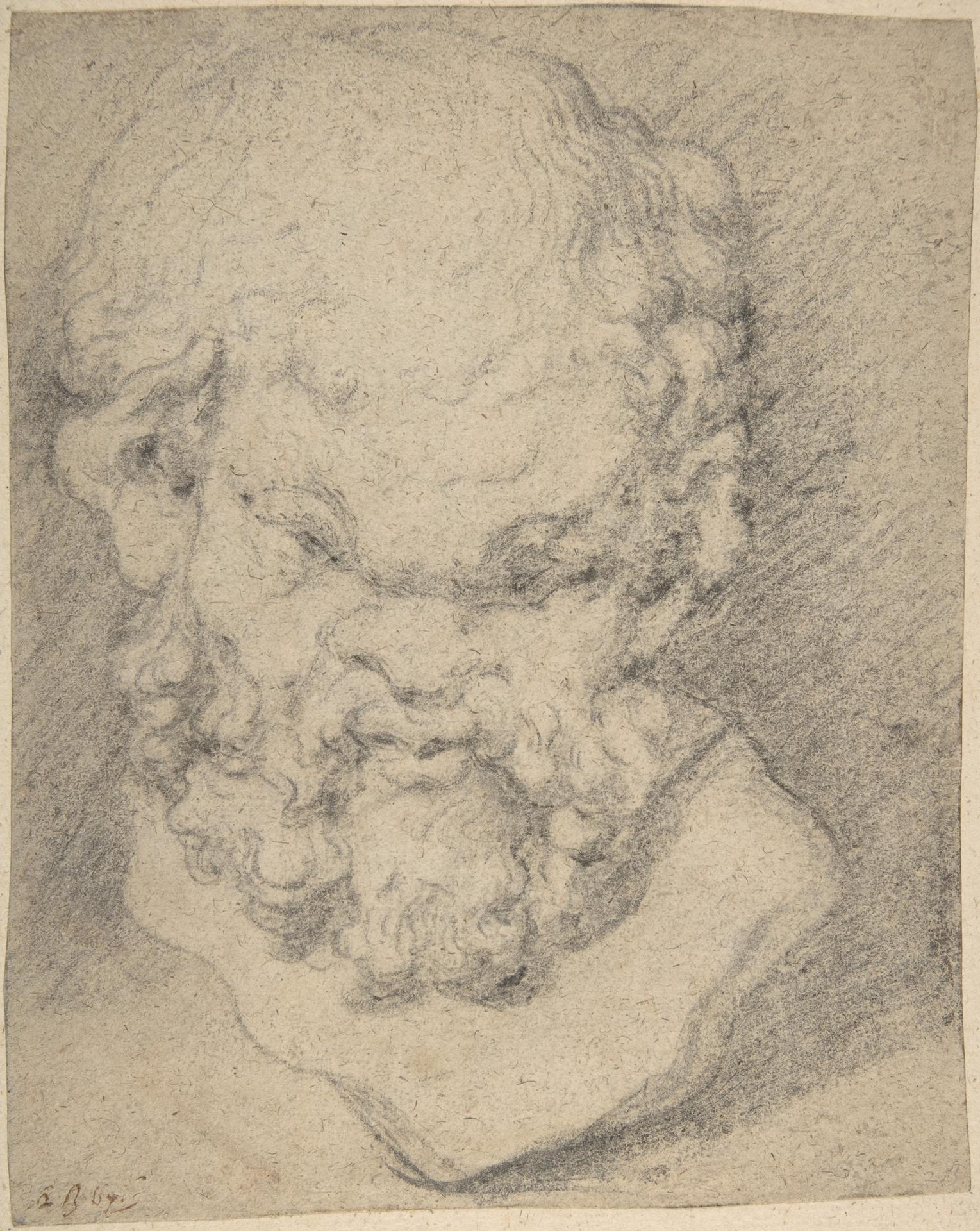
Head of Silenus (early 17th century)
Original title: Head of Silenus
kurzbeschreibung
Peter Paul Rubens drew the head of Silenus in the early 17th century using black chalk on light brown paper. The sheet presents a pensive, bearded head with curly hair that dominates the center of the image.
Description
Curly, wavy hair frames the head, rendered with vigorous strokes. The facial expression appears thoughtful and slightly melancholic; the gaze is cast down, the mouth slightly open. The beard is thick and wavy, a mix of short and long hairs. Varying stroke densities and line directions create the shading. The layout is centralized and contains no other objects or figures.
Context
Rubens made this drawing in the early 17th century, when he was deeply engaged with mythological and bacchanalian themes. Silenus, the companion of Dionysus, was a frequent motif in Baroque art and often stood for both intoxication and wisdom. The sheet likely served as a study for a larger painting or as an independent work demonstrating the expressive power of chalk.
Impact
The realistic and detailed execution aligns with 17th-century art. The head's melancholic aura and the lively stroke work give the piece an immediate emotional presence that captivates the viewer.
Technique
Rubens worked with black chalk on light brown paper, a material that allows fine transitions of light and shadow. The shading arises from varying density and direction of strokes, which gives the view a sculptural quality.
AI-generated description text
Source: Metropolitan Museum of Art · Public Domain (CC0 1.0)