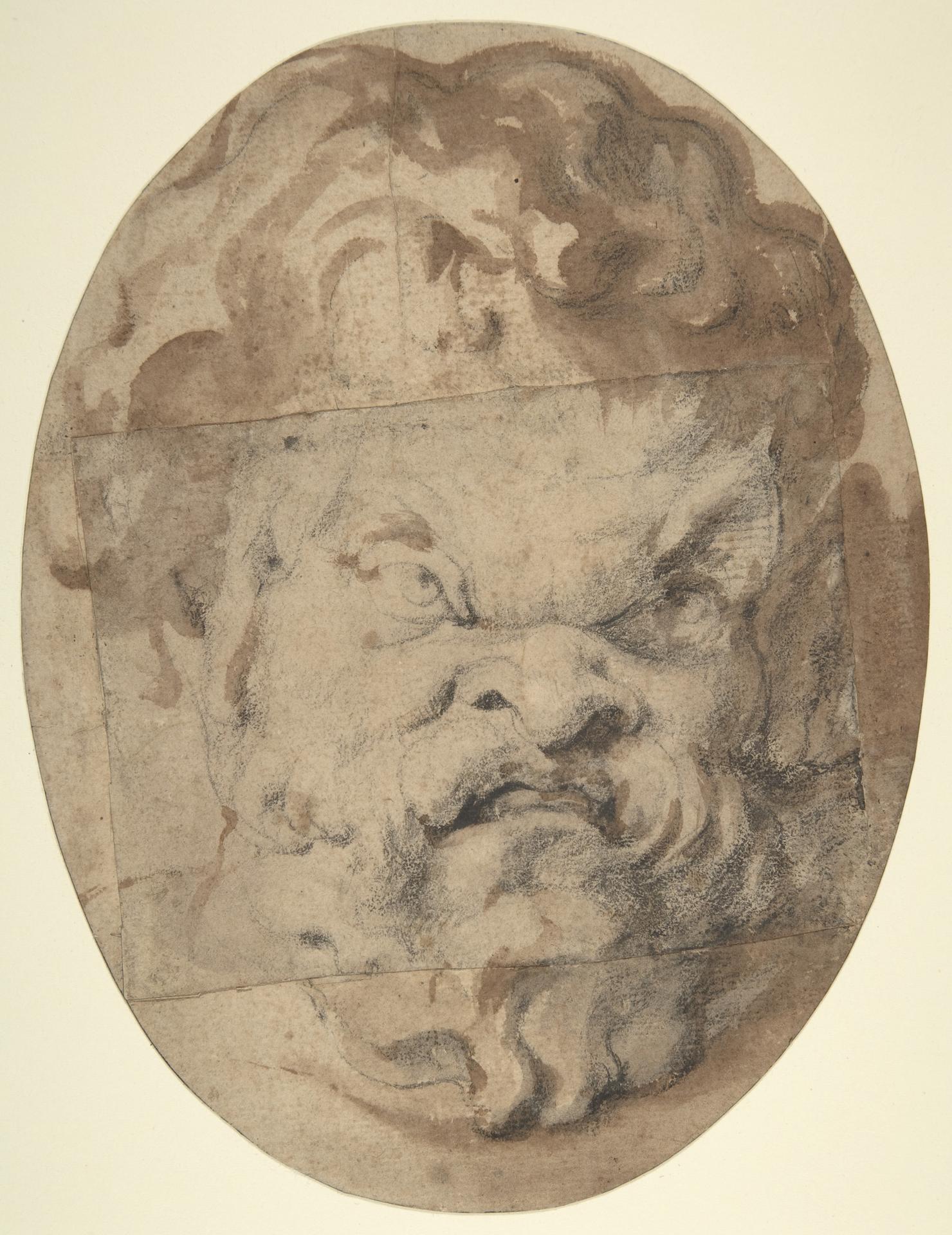
Head of a Satyr (Silenus)
Original title: Head of a Satyr (Silenus)
kurzbeschreibung
A satyr's head with curly hair, a broad nose and a thick beard: this is how Peter Paul Rubens's sheet Kopf eines Satyrs (Silenus) presents itself, made around 1620–30. The drawing in black and brown tones portrays the mythological hybrid of man and goat.
Description
Locks and waves play around the oval head, executed in dark tones and modelled with brushstrokes and shading. Striking is the broad nose, slightly curved upward, along with a short, dense beard. Large, round eyes with clearly visible lids and pupils give the face a serious, thoughtful expression. The white, unadorned background brings the head fully into view; shading and brushstrokes lend it plasticity.
Context
Around 1620–30, during his time as a leading Baroque painter in Antwerp, Rubens made this drawing. Satyrs and sileni were among the popular motifs of the Renaissance and Baroque, often as embodiments of untamed nature. The sheet probably served as a study for a larger painting or as an independent work for collectors. For quick, expressive figure sketches, Rubens often used black chalk and brown ink.
Impact
The drawing feels lively and almost sketch-like; it gives the satyr an immediate presence. Finely graded shading meets bold brushstrokes, creating a sensual texture that highlights the wild and at the same time thoughtful nature of the figure. The serious gaze invites reflection on the human features within the mythological.
Technique
Black chalk and brush with brown ink on paper—a combination typical of Rubens's studies. The chalk established contours and details, while the ink created depth and shading in fine and broad brushstrokes. This allowed form and texture to be captured quickly yet precisely, as the rendering of hair and beard shows.
AI-generated description text
Source: Metropolitan Museum of Art · Public Domain (CC0 1.0)