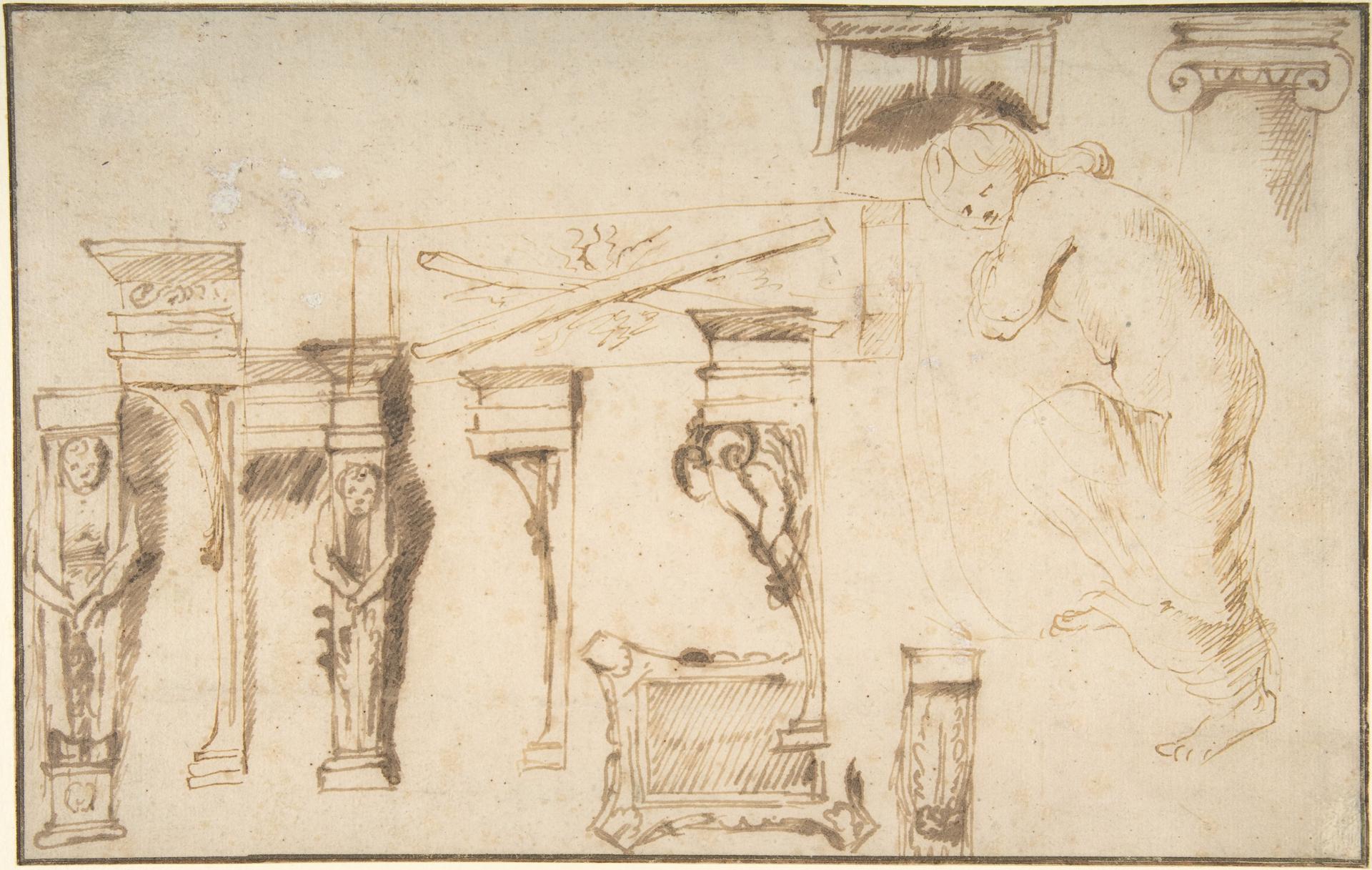
Design for a Chimney Place and Study of a Nude Female Figure
Original title: Design for a Chimney Place and Study of a Nude Female Figure
kurzbeschreibung
This sheet from the 17th century comes from an unknown Flemish draughtsman. It shows a study of a nude woman in a niche and a design for a fireplace. The drawing is executed in pen and brown ink, measuring 19.2 x 30.2 cm. Figurative and architectural elements combine in a sketchy yet detailed manner.
Description
A nude woman, barefoot and wrapped in a simple garment, leans forward in a niche, holding an object. Before her rises an elaborately articulated fireplace structure with columns and capitals, decorated with angels or mythological figures. Brown and gray tones dominate the image, which is shaped by brushstrokes and hatching. The light falls evenly, without strong shadows or highlights. A simple border surrounds the entire arrangement.
Context
The 17th century and the attribution to an anonymous Flemish artist suggest an origin in the Southern Netherlands. The fireplace design likely relates to interior decoration or decorative art, while the nude study reflects the academic practice of figure drawing. Because the creator is unknown, patrons or workshop affiliations cannot be established. The sheet belongs to the collection of the Metropolitan Museum of Art and is digitized there as public domain (CC0).
Impact
A calm, contemplative mood emanates from the drawing, carried by the muted colors and even light. The delicate figure study and monumental architecture create a charming contrast between organic movement and static structure. The sheet feels like an intimate work from the workshop, offering insight into the genesis of artistic ideas.
Technique
Pen and brown ink on paper form the basis; brushstrokes and hatching complement the lines. The framing lines are also drawn in brown ink. This allows both fine details and loosely sketched areas to be executed, as was typical for design drawings of that period.
AI-generated description text
Source: Metropolitan Museum of Art · Public Domain (CC0 1.0)