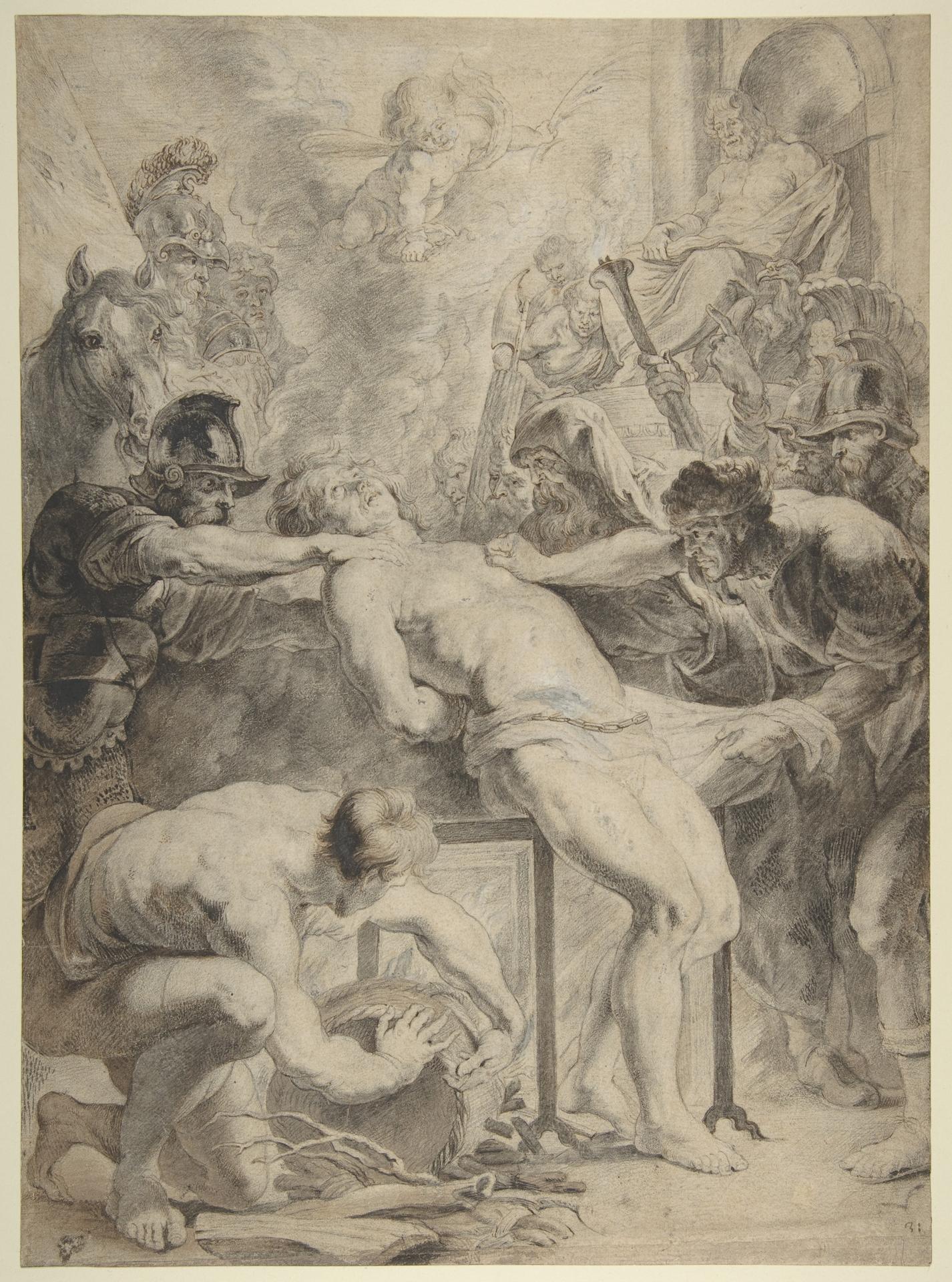
Martyrdom of Saint Lawrence (early 17th century)
Original title: Martyrdom of Saint Lawrence
kurzbeschreibung
Peter Paul Rubens drew the Martyrdom of Saint Lawrence in the early 17th century. The sheet combines black chalk, pen and brown ink, brush with brown wash, and white heightening; the outlines were traced with a stylus for transfer.
Description
Saint Lawrence lies on a table, surrounded by soldiers. One presses a sword to his throat, another thrusts a wooden spit into his back, and a third kneels before him. From a throne, a man—likely the emperor—watches the proceedings; above the table hovers an angel. The layout is dynamic and crowded with figures, each caught in a different phase of the action.
Context
Likely intended as a preliminary study for an altarpiece or print, as the traced contours suggest. In the Catholic Counter-Reformation, the martyrdom of Lawrence was a sought-after subject because it demonstrated the triumph of faith over persecution. Rubens was then in Italy, studying antique and Baroque models—hence the dramatic arrangement.
Impact
The drawing thrives on tension and the vivid account of the martyrdom. Bold strokes meet washed areas, making the scene feel immediate and almost theatrical.
Technique
Rubens used a mixed technique: black chalk, pen and brown ink, along with brush and brown wash and white heightening. He traced the contours with a stylus to transfer the design onto another support—a common workshop procedure.
AI-generated description text
Source: Metropolitan Museum of Art · Public Domain (CC0 1.0)