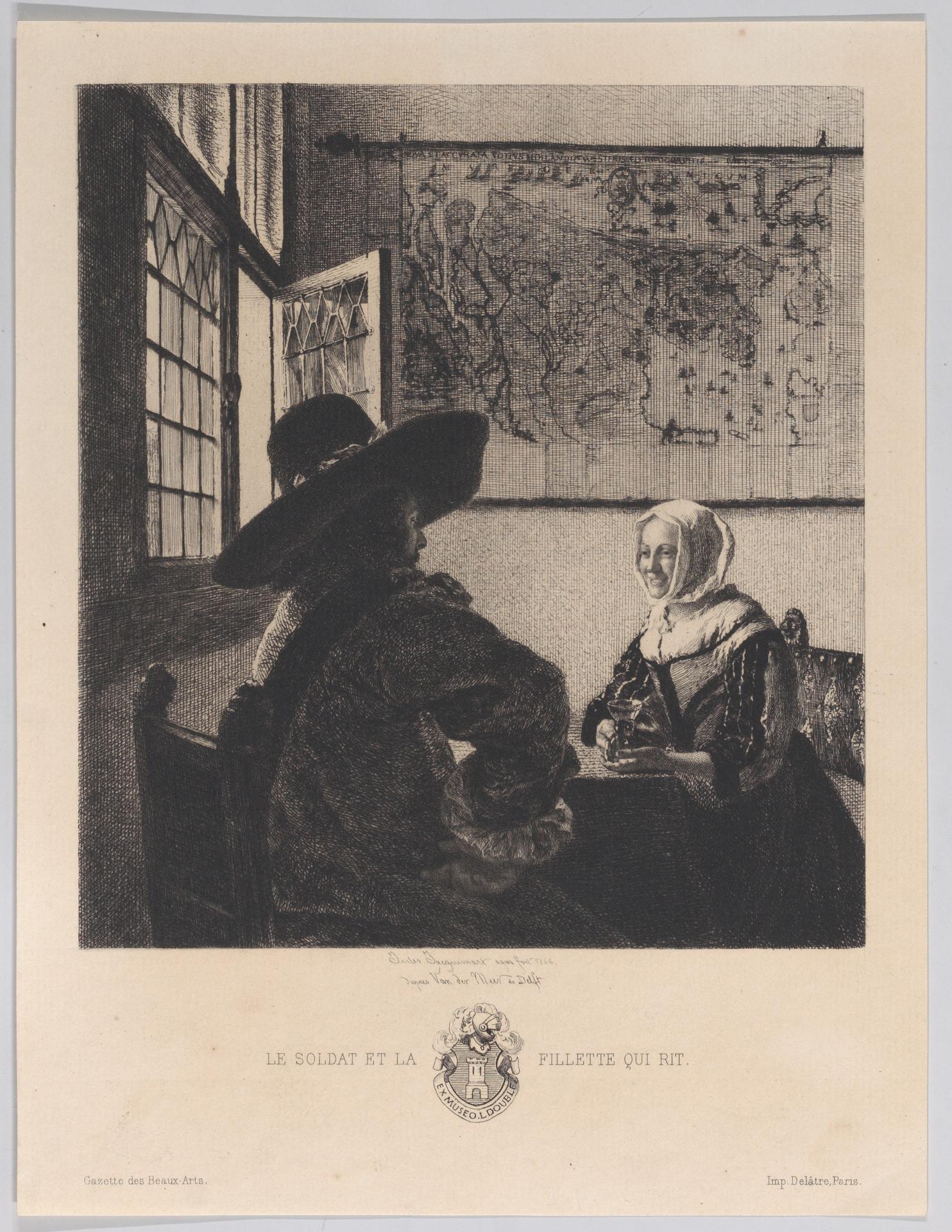
Officer and Laughing Girl, after Vermeer (1866, Met-Objekt 1008)
Original title: Officer and Laughing Girl, after Vermeer
kurzbeschreibung
Jules-Ferdinand Jacquemart etched this work in 1866 after Johannes Vermeer's painting of the same name. An officer and a laughing woman sit at a table within a Dutch interior. The print is the sixth state of six.
Description
At a table, two figures face each other: on the left, a man in a broad dark hat and fur-trimmed coat; on the right, a woman in Dutch dress with a headscarf and blouse, a glass in her hand, laughing. A wall map and a casement window close off the space. The arrangement is balanced, the woman on the right, the man on the left. Muted greys define this meticulously rendered image.
Context
This etching was made in 1866 as a reproductive print after a Vermeer painting. The original dates from around 1658 and belongs to the genre painting of the Dutch Golden Age. Jacquemart was known as a skilled etcher who often reproduced works by old masters. Six states of the print attest to thorough reworking of the plate and high craft standards.
Impact
A calm, intimate mood emanates from the sheet, intensified by the monochrome grey. Figures and interior are rendered so precisely that historical distance becomes palpable, while the laughing woman brings movement into the scene. The result reads as a respectful homage to Vermeer, whose interplay of light and shadow has been translated into the language of printmaking.
Technique
The etching is an intaglio process: the drawing is scratched into a wax layer on a copper plate and then etched. With fine lines and hatching, Jacquemart transferred the light and shadow effects of the painting. Since the impression is in the sixth state, the plate was reworked several times.
AI-generated description text
Source: Metropolitan Museum of Art · Public Domain (CC0 1.0)