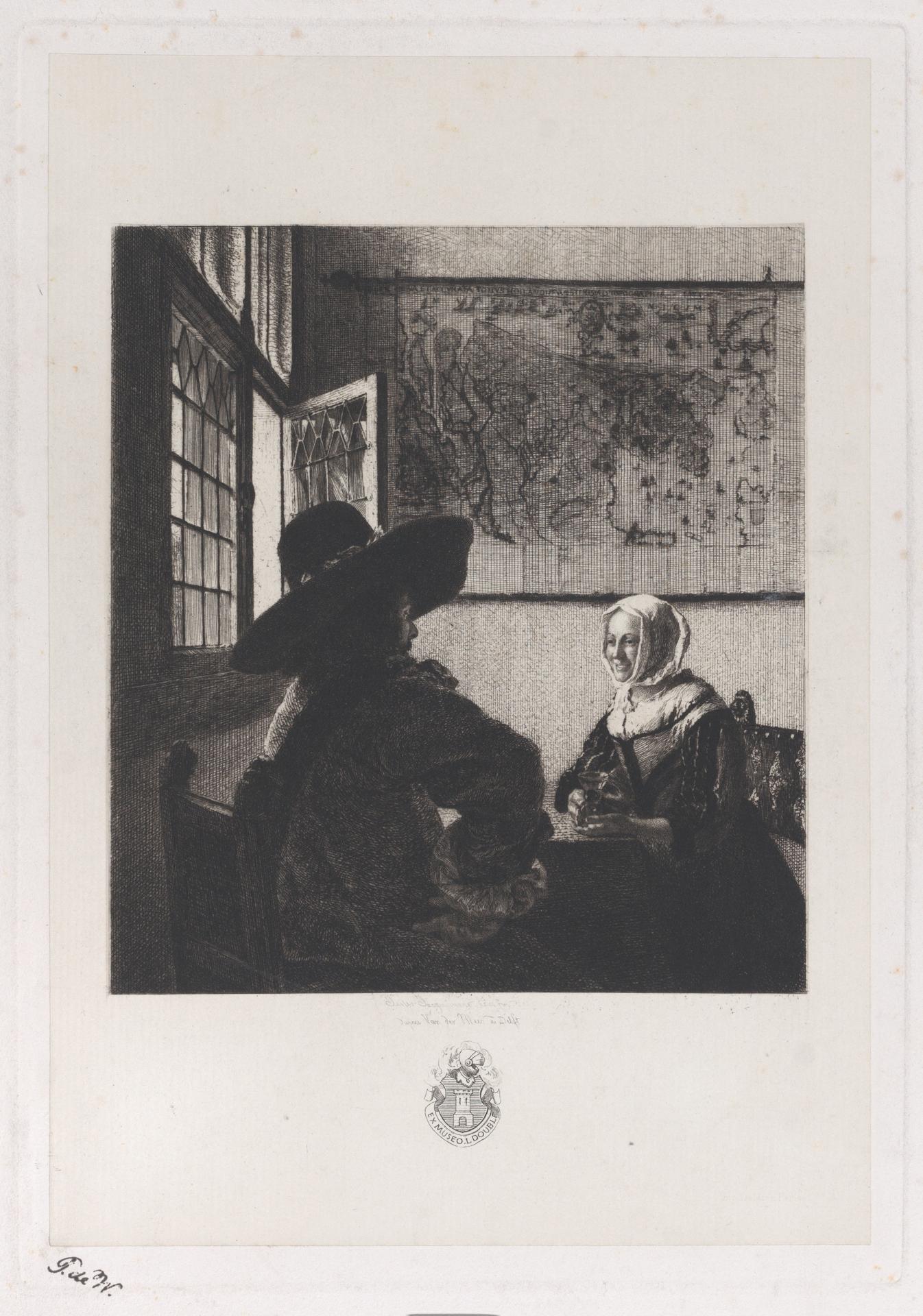
Officer and Laughing Girl, after Vermeer (ca. 1866)
Original title: Officer and Laughing Girl, after Vermeer
kurzbeschreibung
What sets this print apart from related depictions is its status as the fourth state of six, a detail that reveals the plate's evolution. Jules-Ferdinand Jacquemart created this etching around 1866, an interior scene with two figures at a table, directly after Jan Vermeer's painting 'Officer and Laughing Girl'. Unlike many contemporary reproductions, it was printed on chine collé, lending a distinct quality to the impression.
Description
Two seated figures occupy the left half of the image: one wearing a large hat and traditional clothing, the other laughing and wearing a head covering, both at a table. To the right, a window with leaded panes and a wall map extend across the background. Light enters from outside through the window. Fine lines and shading define this monochrome etching.
Context
Jacquemart based this work on a painting by Jan Vermeer now in the Frick Collection, New York. During the 1860s, Vermeer's oeuvre was rediscovered through publications and exhibitions. Jacquemart, primarily a printmaker, devoted himself especially to reproductions of old masters. The fourth state of six documents the progressive reworking of the plate.
Impact
Calm and intimacy emanate from this etching, achieved through delicate linework and the rendering of light. The figures and space feel close to the original without being a mere copy. The monochrome approach heightens the contrasts of light and dark and the texture of the scene.
Technique
For this print, Jacquemart used etching on chine collé, a technique in which thin Japan paper is adhered to a support sheet. He employed drypoint and etching to achieve fine lines and shading. The fourth state of six attests to an advanced stage of work on the printing plate.
AI-generated description text
Source: Metropolitan Museum of Art · Public Domain (CC0 1.0)