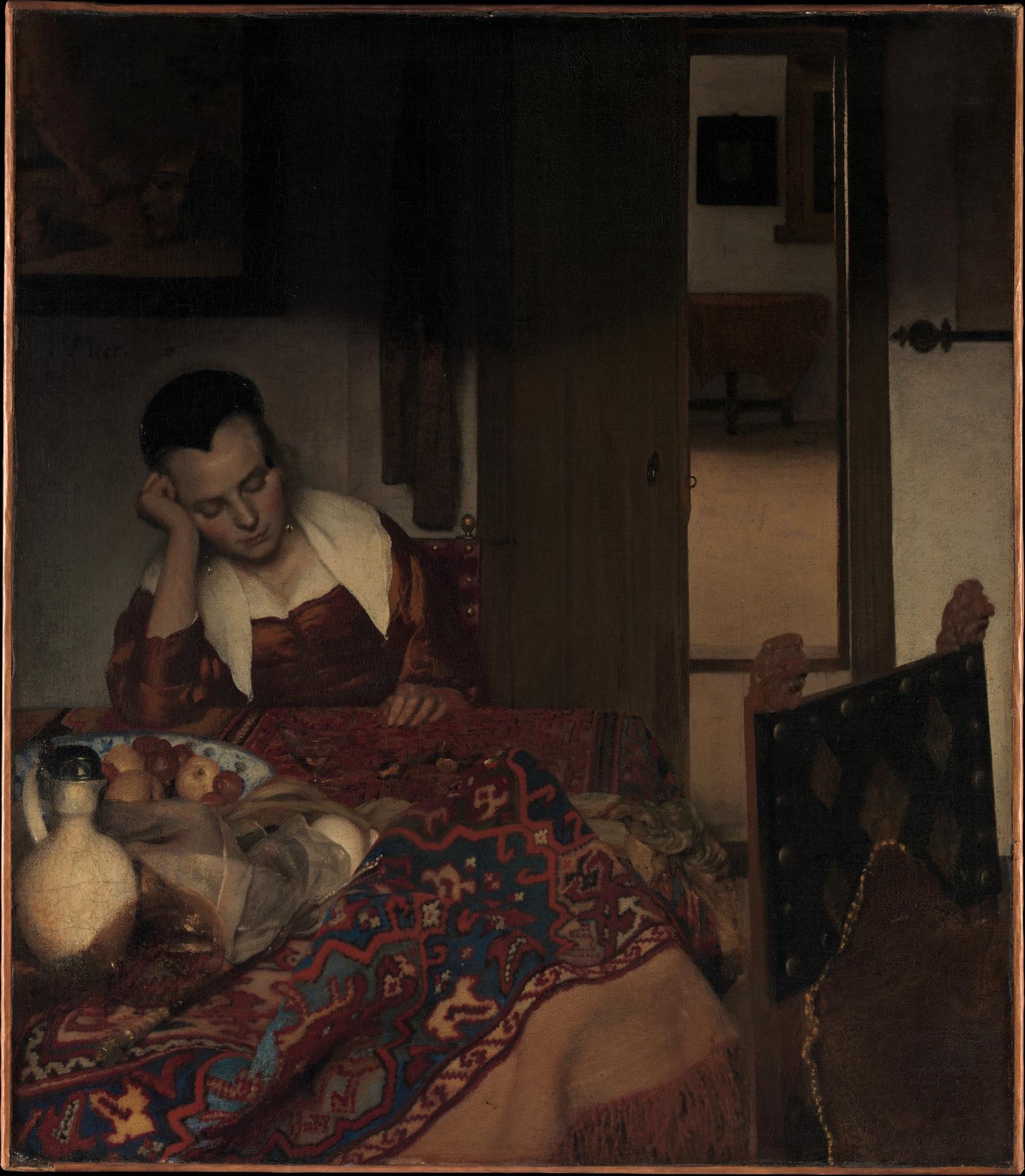
A Maid Asleep
Original title: A Maid Asleep
kurzbeschreibung
In Johannes Vermeer's "Sleeping Girl" (ca. 1656–57), a young woman has dozed off at a table. This oil on canvas, measuring 87.6 × 76.5 cm, is one of the painter's early domestic interiors. A quiet, familiar mood emanates from it.
Description
The woman leans on a chair, her upper body turned slightly to the left, her hand resting against her forehead, her gaze lowered. She wears a red-brown dress with a white collar; her dark hair is combed back. On the table sit a white jug, a fruit bowl, a cloth, and another piece of fabric; over them lies a blue-and-red striped, patterned cover. A door in the background stands ajar, and two paintings hang on the wall. Muted colors and soft light create a peaceful atmosphere.
Context
The painting dates from Vermeer's early period, when he turned away from history painting toward everyday life. It is among his first interior scenes and reveals the influence of the Utrecht Caravaggisti as well as Pieter de Hooch. Rediscovered in the 19th century, it now belongs to the Metropolitan Museum of Art.
Impact
From the first glance, the stillness draws the viewer in. The soft light and the balanced distribution of figure and objects make the scene feel close and unforced. The slight asymmetry between the girl and the things around her seems natural, almost incidental, and deepens the concentrated calm.
Technique
Oil paint on canvas, applied in thin, glazing layers, allows the gentle modeling of light. The textures of fabric and ceramics are precisely captured—evidence of a sure command of the painting method of the Dutch Golden Age.
AI-generated description text
Source: Metropolitan Museum of Art · Public Domain (CC0 1.0)