City and Country
Original title: City and Country
kurzbeschreibung
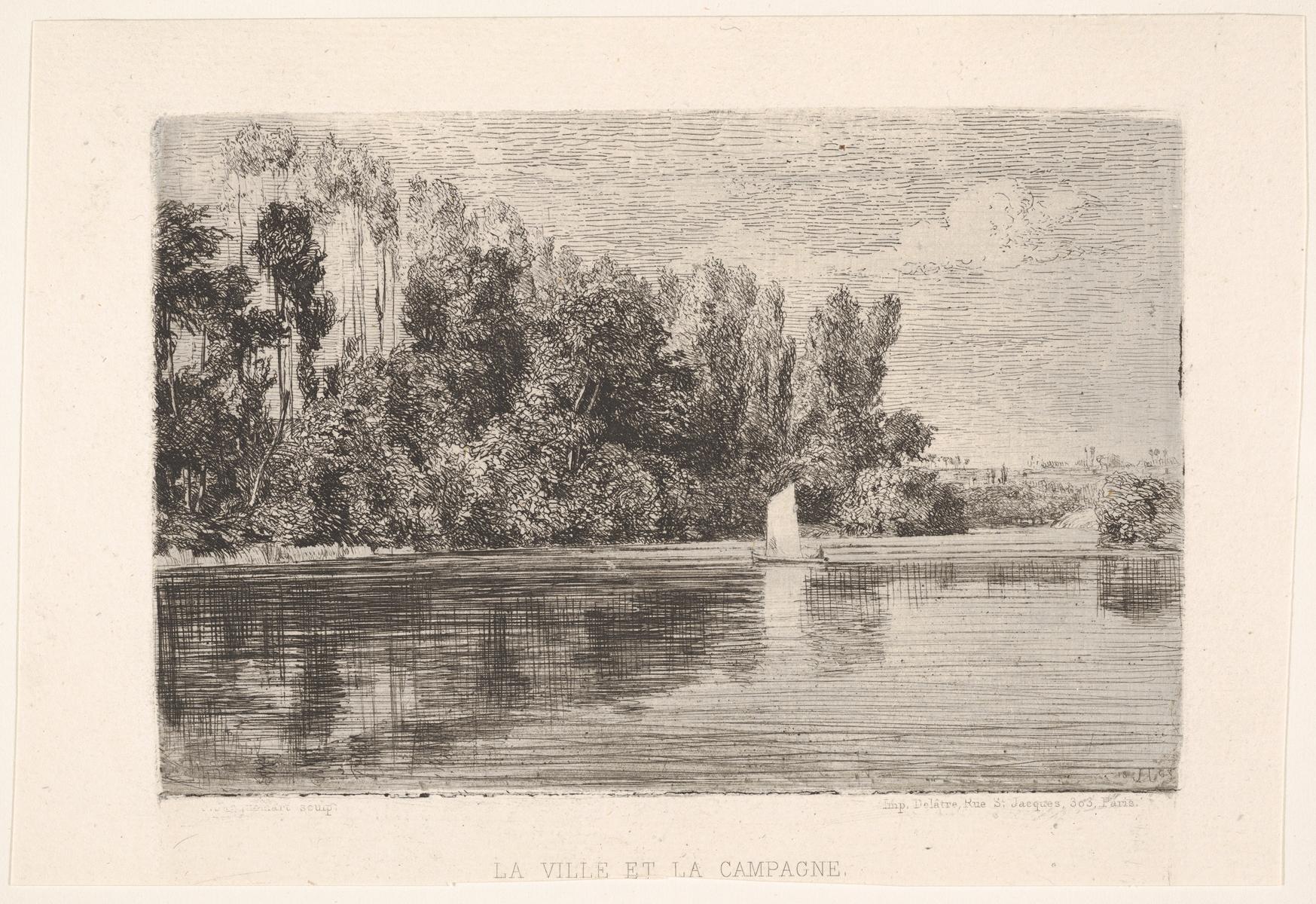
Jules-Ferdinand Jacquemart produced this etching in 1868 under the title Stadt und Land (City and Country). It presents a river landscape with wooded banks, while a town looms in the distance.
Description
A placid river sweeps across the full width of the sheet. Dense trees line the left bank and stretch toward the horizon; on the right, buildings and more trees suggest a town. Thin clouds veil the sky, and their reflection on the water creates a quiet mood. The etching remains in black and white, drawing out the textures of nature and architecture. The layout is horizontal, with the river guiding the eye toward the urban landscape.
Context
Jules-Ferdinand Jacquemart, a French printmaker, became known for his etchings after artworks and landscapes. This sheet dates from 1868, when etching in France enjoyed a fresh flowering. It was based on a work by Gustave Courbet, a leading figure of Realism. The theme of city and country reflects the period's interest in the tension between nature and urbanization.
Impact
The mirror-smooth water and soft clouds give the sheet a calm, contemplative aura. Fine lines and a clear structure produce a precise, almost idyllic feel that draws the viewer into the landscape.
Technique
This work is an etching: the drawing was incised into a metal plate and bitten with acid. Jacquemart used the process to achieve fine lines and graduated tones that capture the details of trees and buildings. The paper measures 14 x 20.5 cm, the plate 11 x 16.1 cm.
AI-generated description text
Source: Metropolitan Museum of Art · Public Domain (CC0 1.0)