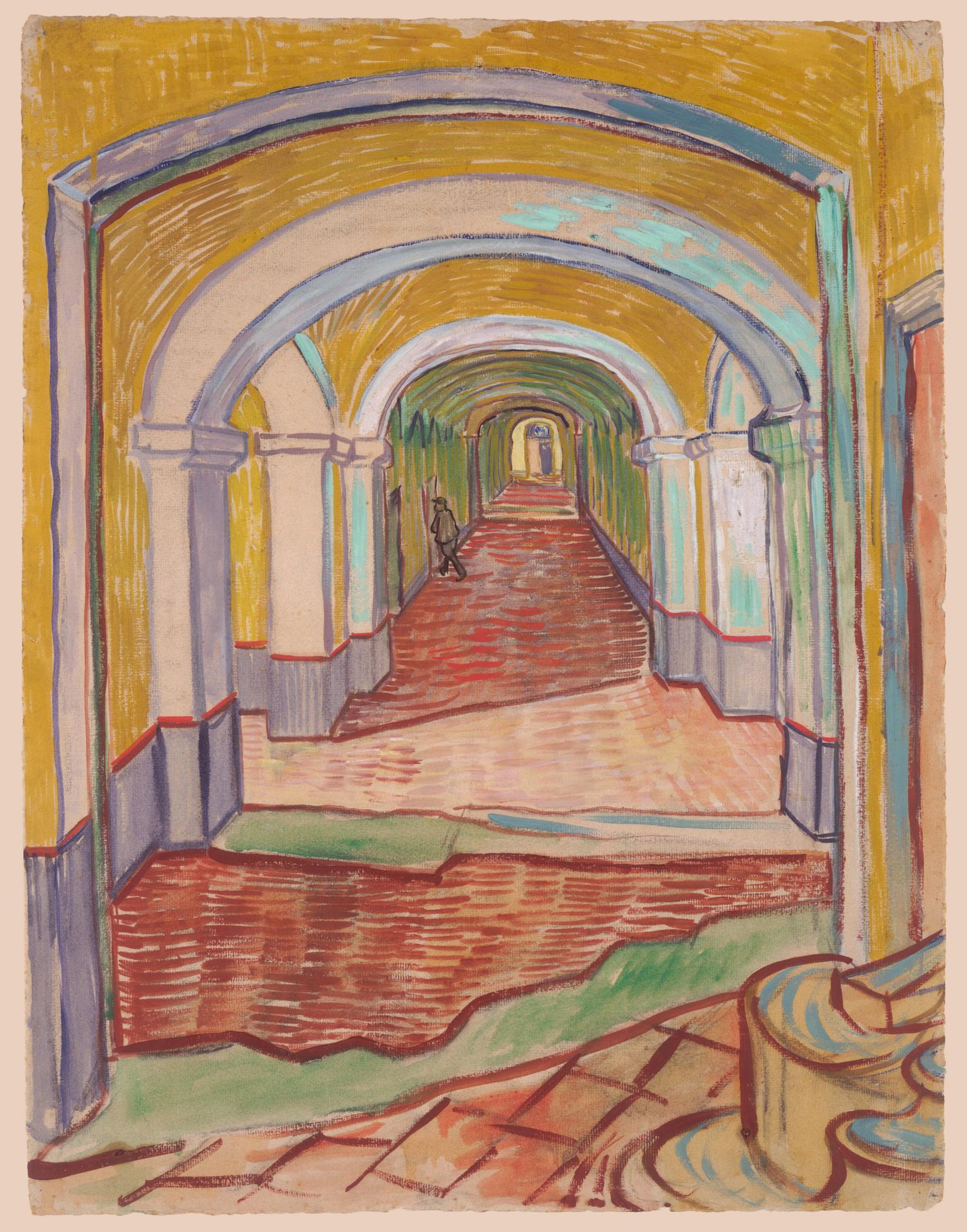
Corridor in the Asylum
Original title: Corridor in the Asylum
kurzbeschreibung
Vincent van Gogh painted "Corridor in the Asylum" in September 1889, during his stay at the Saint-Paul-de-Mausole psychiatric hospital in Saint-Rémy-de-Provence. He used brush and oils over black chalk on pink laid paper. The picture shows a long, vaulted corridor with a single person walking into the distance.
Description
A long corridor with arched walls and ceiling opens toward a vanishing point. Yellows and blues dominate the walls, the ceiling appears in a related yellow, and the floor is red. About midway down the corridor, a person moves away from the viewer. The lines are irregular, the colors are vivid, and the layout is symmetrically aligned along the central passage. The floor has a brick-like pattern; the brushstrokes create a slight blur.
Context
The sheet was made after van Gogh voluntarily admitted himself to the Saint-Paul-de-Mausole hospital in May 1889 following a breakdown. He often painted the hospital's surroundings, including interiors like this corridor. The work dates to September 1889, a few months before he left Saint-Rémy in May 1890. It belongs to a series of works in which he recorded the asylum and its architecture.
Impact
Vivid colors and irregular lines create a dynamic, slightly chaotic atmosphere. The corridor's perspectival depth pulls the eye into the picture, while the lonely figure evokes a melancholy mood. Strong colors and the slight blur give the work a high emotional intensity.
Technique
Van Gogh worked with brush and oils over black chalk on pink laid paper—an unusual combination that gives the sheet a special texture. The oils are applied in visible, vigorous brushstrokes that produce the irregular lines and slight blur. Black chalk served as an underdrawing, structuring the composition.
AI-generated description text
Source: Metropolitan Museum of Art · Public Domain (CC0 1.0)